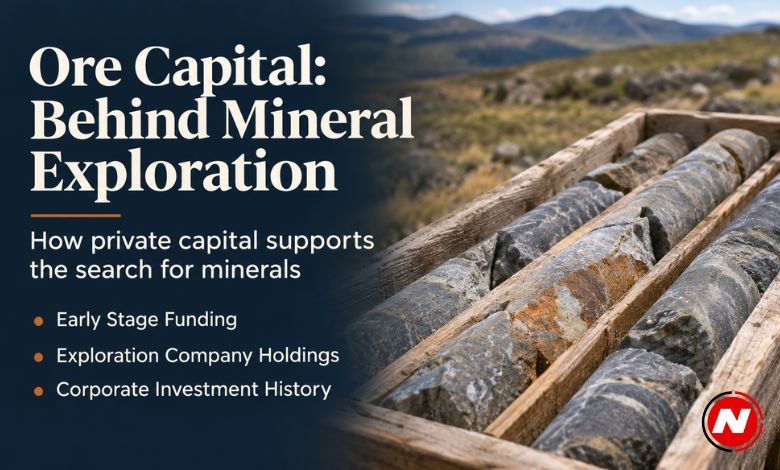
A mineral discovery may begin with a geologist’s idea, but turning that idea into evidence takes money. Before drilling results attract headlines, exploration teams must secure ground, study geological data, and persuade investors that their search deserves funding.
Ore Capital belongs to this earlier, less visible part of the resources industry. The original Canadian investment business held interests in exploration companies and later became known as OCP Holdings Ltd. Its public history includes connections with Inflection Resources, Headwater Gold and a significant transaction involving Crest Resources.
Yet the company’s story requires careful reading. Historical investments can be mistaken for current holdings, while similar business names can point readers towards entirely different organizations. Understanding what the firm did begins with separating its documented history from assumptions.
A Private Investment Business with an Exploration Focus
The original business operated as a private investment group focused on mineral exploration opportunities. An Inflection Resources information circular identifies Tero Kosonen as a co-founder in 2017 and describes the group’s investment focus as global mineral exploration.
This placed the firm in a specialized market. Exploration businesses investigate whether an area contains mineral deposits worth developing. Their work can involve geological mapping, sampling, surveys and drilling, often before there is any certainty about commercial production.
Corporate records provide a clear milestone in the company’s development. British Columbia’s registry records the change from Ore Capital Partners Ltd. to OCP Holdings Ltd. on 26 August 2020.
That change explains why different names appear across historical documents. Earlier announcements use the original identity, while later disclosures refer to OCP.
Garry Stock also appears in the documented corporate history. Crest Resources identified him as a director of both Crest and OCP in its December 2020 transaction announcement.
These records establish specific roles and events. They provide a stronger basis for understanding the business than descriptions based on its name alone.
Why Early Mineral Exploration Needs Specialist Capital
The appeal of exploration investment lies in the chance to identify something valuable before its full potential is understood. The difficulty is that promising geological evidence does not always lead to a workable mine.
Consider a typical exploration project. A company identifies an interesting target and begins gathering information. Surface samples may support further investigation, but drilling is needed to understand what lies below the ground.
Each stage requires funding. Even encouraging results may raise more questions about the deposit’s size, consistency, depth, or accessibility.
An investor can participate by buying shares in the exploration company. That gives the investor an ownership interest and provides the business with money to continue its work.
A private investment holding company can build a portfolio of these interests. Its exposure comes through the companies it owns shares in, with each investment carrying its own opportunities and uncertainties.
This structure helps explain the original firm’s business model. Public disclosures described OCP as a private investment holding company and identified exploration company shares among its core assets.
The distinction matters because a shareholder and a mine operator perform different roles. An investment company may benefit from a portfolio business’s progress without directly managing its drilling program or running its projects.
Ore Capital’s Connections with Two Exploration Companies
Inflection Resources and Headwater Gold provide the clearest examples of the firm’s publicly documented investment interests.
In an August 2020 announcement, Crest Resources identified 14,750,001 Inflection Resources common shares and 12,038,443 Headwater Gold common shares as core assets of the investment business.
Those figures reflect the holdings disclosed at that time. They should not automatically be presented as the portfolio today.
The announcement linked Inflection to exploration in Australia’s Lachlan Fold Belt and the Croydon goldfield. It described Headwater as having a portfolio of exploration projects in Nevada, Idaho and Oregon.
Together, the investments connected the holding company with exploration activity in different geographical settings. Each underlying business had its own projects, technical priorities and funding requirements.
Headwater later reached another corporate milestone. Its common shares began trading on the Canadian Securities Exchange on 8 June 2021 under the symbol HWG.
The company’s announcement outlined a strategy focused on discovering high-grade precious metal deposits in the western United States.
A public listing can broaden an exploration company’s access to capital and introduce it to more investors. However, it does not settle the geological questions surrounding its projects.
That is the key takeaway from these portfolio connections: they show participation in the search for discoveries, while the eventual commercial outcome depends on further evidence and development.
The Crest Resources Transaction That Brought Greater Visibility
Private investment businesses often become easier to understand when they enter transactions with listed companies. Public announcements reveal details that might otherwise remain difficult to find.
For OCP, a significant example arrived in December 2020.
Crest Resources announced that it had completed the acquisition of 10,566,667 OCP common shares, representing a 36% interest. In exchange, Crest issued 18,647,123 of its own common shares.
The transaction gave Crest an ownership position in the holding company. Through that stake, it gained indirect exposure to OCP’s assets.
The announcement is also useful because it explicitly connects the former company name with OCP Holdings. This helps readers follow the business across the 2020 name change.
However, the transaction needs to remain attached to its date. It records what Crest acquired in December 2020 and does not, on its own, establish Crest’s ownership position today.
This is a common challenge when researching private investment firms. A detailed historical announcement can remain highly visible online long after the circumstances it describes have changed.
Reading the date alongside the headline prevents a past transaction from becoming an inaccurate present-day claim.
Similar Names Can Lead to Different Businesses
One of the most confusing parts of researching this subject is that a familiar name does not always identify the same legal entity.
The British Columbia registry illustrates the problem. Its published notice records the original company becoming OCP Holdings, but also records a different numbered company adopting the former name.
The company numbers distinguish those entities, even when the wording looks familiar.
A UK business called Ore Capital Limited also appears in Companies House records. It was incorporated on 26 November 2021 under company number 13768366.
That registration establishes a separate UK legal entity. It does not, by itself, prove a connection with the original Canadian investment group.
Brazil’s ORE Investments adds another distinction. Its official description identifies an independent mining investment fund manager founded in Minas Gerais in 2019.
The Brazilian firm describes an investment approach covering several stages of mining assets, including exploration, environmental licensing, construction, and operation.
These businesses may appear together in search results because their names and industry interests overlap. Their histories should still be examined separately.
For readers, the most useful identifying details are the full legal name, registration number, country, and document date. Together, these provide a clearer foundation than a short brand name.
Conclusion
Ore Capital’s documented history offers a useful view of the money behind early mineral exploration. Its exploration company holdings and the Crest Resources transaction show how a private investment business can participate in projects through corporate ownership.
Understanding that history depends on keeping names, dates, and legal entities in their proper context. Historical holdings explain where the business had exposure, while company records help establish which organization a document concerns.
The prospect of a major discovery may capture attention, but the funding decisions behind the search are part of the story too.
(FAQs)
What is Ore Capital?
In this article, the name refers to the original Canadian private investment business later renamed OCP Holdings Ltd. Its documented interests included shareholdings in mineral exploration companies.
Who helped establish the original firm?
An Inflection Resources information circular identifies Tero Kosonen as a co-founder in 2017. Other corporate disclosures identify Garry Stock as an associated director.
When did the business become OCP Holdings?
British Columbia’s corporate registry records the name change on 26 August 2020. The original entity’s company number was 1114957.
Which investments were publicly disclosed?
Crest Resources’ 2020 announcements identified significant shareholdings in Inflection Resources and Headwater Gold. These are historical disclosures, so later documents are needed to establish subsequent ownership changes.
Is the similarly named UK company the same organization?
A connection should not be assumed. The UK company has its own registration number and a 2021 incorporation date. Similar names alone are insufficient evidence of a shared corporate identity.