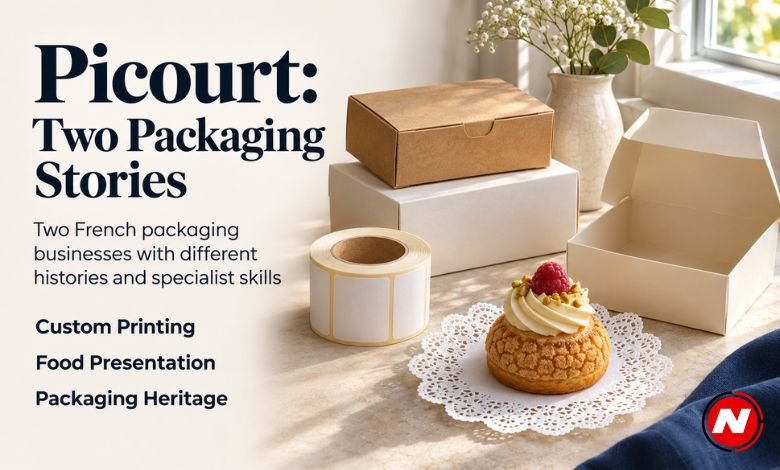
A carefully printed label can give a bottle its identity. A delicate paper lace can turn a simple cake display into something memorable. These small details rarely receive much attention, yet they sit at the centre of the businesses people discover when searching for Picourt.
The name is associated with two distinct French packaging companies: Groupe Picourt and Picourt-Cabis. Their work overlaps in materials and presentation, but their histories and specialities follow different paths.
One offers a broad range of printing and packaging services for modern businesses. The other has roots in nineteenth-century Paris and a long connection with food presentation. Looking at them separately reveals how practical manufacturing and decorative craftsmanship continue to shape the way products reach customers.
One Name, Two Different Business Identities
A shared name can make two businesses appear more closely connected than their individual histories suggest. That is especially easy in packaging, where terms such as labels, cardboard boxes and custom printing appear across many manufacturers’ product ranges.
Here, the main distinction is their commercial focus. The printing group works across several industries, producing packaging and printed materials for different business needs. The historic food-presentation specialist is closely associated with the products used by pastry chefs, chocolatiers and catering professionals.
Their ranges are not completely separate. Both can provide customised items, and both work with paper and cardboard. However, similar materials do not mean identical expertise, production methods or company backgrounds.
For anyone researching these businesses, the complete company name matters. So do the location, product description and intended application. These details help readers avoid attaching one manufacturer’s heritage, services or certification announcements to the other.
The difference becomes clearer when we move beyond the name and look at what each business actually makes.
Groupe Picourt and the Business of Modern Printing
The printing group presents itself as a French family business with more than 40 years of experience. Its services include adhesive labels, cardboard packaging, flexible packaging and commercial printing, alongside products such as brochures, catalogues and books.
That variety reflects how businesses introduce and sell their products. A new cosmetics range, for example, may need labels, outer cartons and printed promotional material. Each item has a different purpose, but customers should recognise the same brand across all three.
The group serves sectors including food, cosmetics, pharmaceuticals, hospitality, and wines and spirits. A label for a drinks bottle and a carton for a beauty product may require different materials and finishes, even when both aim for a premium appearance.
Its advertised support extends from prototypes to production runs of different sizes. This matters because a design that looks convincing on a screen may behave differently once printed, folded or applied to a container.
Good packaging therefore begins with practical questions. How large is the product? Where will it be stored? What information must remain clear? The answers influence the finished result as much as the artwork itself.
Picourt-Cabis and the Art of Food Presentation
The food-presentation manufacturer traces its origins to Paris in 1886. According to its published company history, the original business supplied the Russian tsars, the English royal household and the White House.
That heritage gives its story an unusual setting, but the everyday purpose of its work is easier to recognise. Its products help food professionals present, support and package items that have already required considerable care to make.
Decorative paper lace, often called dentelles in French, is one example. Placed beneath a cake or pastry, it creates a visual frame around the food. What looks like a small finishing touch depends on precise cutting and a suitable design.
The company also describes a technical milestone in 1987, when it developed the Baccara machine at the request of Gaston Lenôtre to produce luxury paper lace.
Cabis joined the group in 1995, followed by the move of production to Normandy two years later. The businesses merged in 2013 under the SOMAFI group.
Based in Andé, the manufacturer offers standard and customised products, including presentation boxes, cardboard supports, paper items and display solutions. Its design studio also supports bespoke projects, allowing customers to develop packaging around a particular product or occasion.
What the 2026 Packaging Certification Announcement Means
Beyond company heritage and attractive finishes, packaging buyers need confidence in how materials are handled and products are manufactured. This becomes particularly relevant when packaging is intended for food or other sensitive applications.
On 3 July 2026, the printing group announced BRCGS Packaging Materials certification for its packaging operation. The announcement covered specified manufacturing and printing activities involving adhesive labels, cardboard labels and customised paper cups.
The company described the achievement in terms of production controls, raw-material traceability, good manufacturing practices and its quality organisation.
For customers, the useful detail is the scope of the certification. A statement about a particular operation and its activities should be understood within those boundaries. It should not automatically be extended to every product sold by a wider group.
This is also why buyers benefit from discussing their intended use directly with a manufacturer. Packaging for direct food contact can raise different questions from an outer sleeve or a promotional label.
The announcement highlights a side of packaging that customers rarely see: the procedures behind the finished object. A clear print and a neat fold matter, but so does the process that produced them.
Why Packaging Matters Beyond Its Appearance
Consider the moment a customer collects a cake from a bakery. The decoration may be the first thing they notice, but the supporting board and surrounding box help determine how comfortably that cake makes the journey home.
A similar relationship exists in retail. The label introduces the product, the carton holds it, and the opening experience shapes the customer’s first physical interaction with the purchase.
These are practical design decisions. Packaging needs to suit the item, the staff handling it and the person opening it. An elegant box that takes too long to assemble can become awkward during a busy service.
For businesses comparing suppliers, physical samples can answer questions that photographs leave unresolved. They show the actual texture, print size, folding behaviour and fit around the product.
Material claims also deserve attention. A package should be assessed as a complete item, including coatings, adhesives and separate components. Its appearance alone cannot explain how it should be disposed of.
The stories of these two French manufacturers illustrate the range of knowledge involved. Industrial printing and decorative food presentation approach different needs, yet both depend on choosing details that work together.
Conclusion
Picourt is a name with more than one business story behind it. One company brings together broad printing and packaging services, while the other carries a long heritage in decorative food presentation.
Understanding their differences makes it easier to appreciate their work and research the right supplier. It also reveals why packaging deserves attention: long before a customer opens a box, decisions about its material, shape and finish have already begun shaping the experience.
(FAQs)
What does Picourt refer to?
In this article, the name refers to two distinct French packaging businesses: a printing group serving several industries and a historic manufacturer associated with food presentation. Their complete names help distinguish their services and backgrounds.
Are the two packaging businesses the same company?
They should be treated as distinct businesses with different histories and commercial identities. Their product ranges share some features, but information about one should not automatically be applied to the other.
What does the printing group produce?
Its advertised services include labels, cardboard and flexible packaging, brochures, catalogues, books and other printed materials. It supports projects ranging from prototypes to production runs of different sizes.
When did the food-presentation manufacturer begin?
The manufacturer traces its origins to Paris in 1886. Its company history describes the later arrival of Cabis, the move to Normandy and the merger of the businesses in 2013.
Why are decorative paper products used in pastry presentation?
Paper lace and related presentation products help frame the food and create a considered display. Their suitability depends on the product, dimensions and intended use, so appearance should be considered alongside practical requirements.
What should a business check before ordering custom packaging?
A clear brief should explain the product dimensions, intended use, quantity and preferred appearance. Buyers should also discuss materials, samples, production timing and any documentation relevant to the application.