
Cyber model pricing on OrcaRouter is two shapes, not one range, and OrcaCyber Ultra 1.0 pricing sits at the top of the second one. Six of the eight abliterated cards sit at exactly $0.80 in and $1.60 out; the three post-trained cards form a ladder, two at $3.00/$7.50 and one at $5.00/$10.00 [OURS].
Between the two shapes there is no card at all, and that gap is the most useful thing on the price page. Here is what each rung buys.
The flat tier, in full
| card | in / out | blended 3:1 | cache share |
| DeepSeek V4.1 Flash | 0.80 / 1.60 | 1.00 | 18.75% |
| Qwen3.8 Flash Next | 0.80 / 1.60 | 1.00 | 18.75% |
| GLM 5.3 Flash | 0.80 / 1.60 | 1.00 | 18.75% |
| MiMo V2.6 Flash | 0.80 / 1.60 | 1.00 | 18.75% |
| MiniMax M3.1 Flash | 0.80 / 1.60 | 1.00 | 18.75% |
| Hy4 | 0.80 / 1.60 | 1.00 | 18.75% |
[OURS], read 2026-11-15. Blended is our arithmetic at a 3:1 input-to-output mix.
Six products, one price, and they are not interchangeable. The card with 186.1 tokens a second and the card with 42.2 charge the same. The card with 0.166% errors and the card with 0.938% charge the same. The card that takes audio and the card that takes text and images charge the same.
The other two abliterated cards break the flat line upward: Kimi K3.1 Pro at $4.00/$20.00 (blended $8.00) and GLM 5.3 at $3.00/$5.00 (blended $3.50) [OURS].
The ladder, and what each rung actually buys
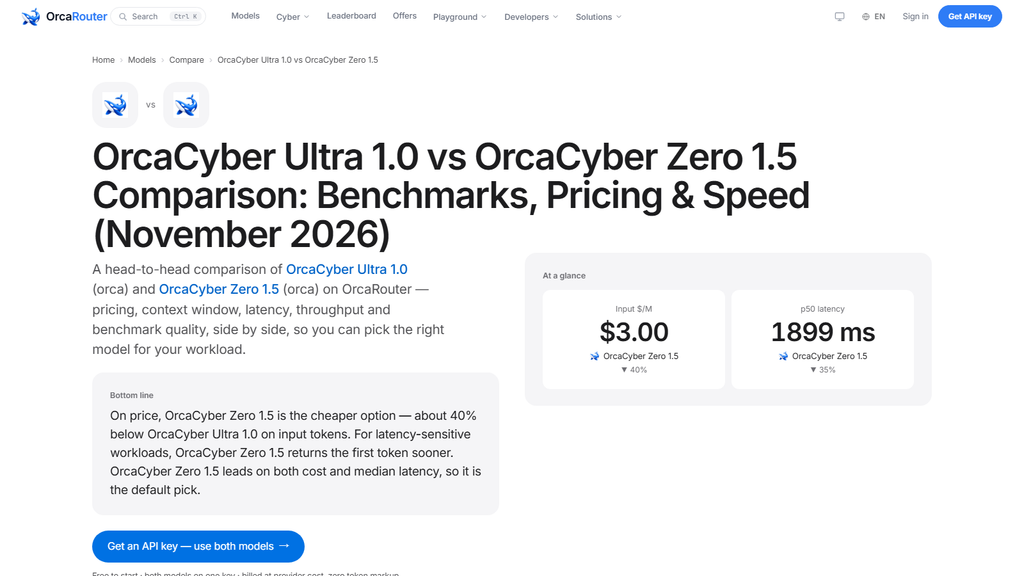
$3.00/$7.50, blended $4.13 — Zero 1.0 and Zero 1.5. Text-only, 1,048,576-token context, 128,000-token output ceiling, chat-completions only, quality 9/10.
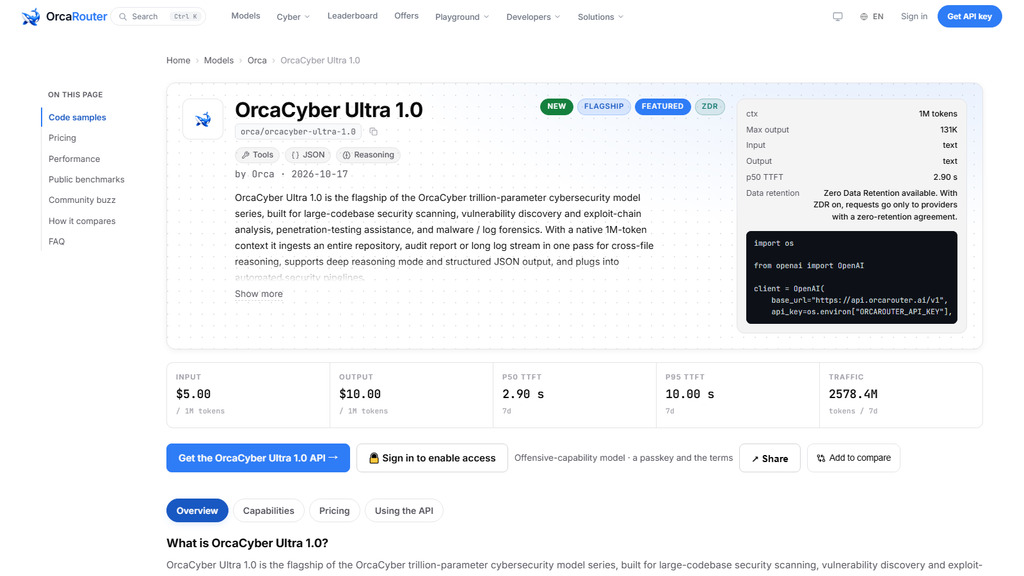
$5.00/$10.00, blended $6.25 — Ultra 1.0. Text-only, 1,048,576 context, 131,072 ceiling, chat-completions only, quality 9/10, 205.7 tokens a second.
The jump from $4.13 to $6.25 is 1.51×, and it buys exactly one thing that is measurable: 205.7 tokens a second against Zero 1.0’s 199.5 and Zero 1.5’s 122.2 [OURS]. Against the earlier card that is 3% more throughput for 51% more money.
Against the later card it is 68% more throughput for the same 51%, which is a real trade — but only if the later card was what you were going to buy.
Why there is nothing between $1.00 and $3.50
Because the two shapes are built differently, and the price follows the build.
An abliterated card is a checkpoint with a direction projected out. The vendor’s cost is the edit plus serving, and the base checkpoints are cheap: $0.15/$0.60 for DeepSeek, $0.14/$0.28 for MiMo, $0.15/$0.50 for GLM Flash [OURS]. A 3.8 to 5.7 multiple on a cheap base lands in the same place every time.
A post-trained card is trained for the job. The cost is in the training, and it does not scale down with a cheap base because there is no cheap base — the model is the product.
That is why the six flash cards cluster and the three post-trained cards ladder: one price is a multiple of something else, the other is a price.
What the gap means for a budget
A security team running continuously does not buy one card. It buys a mix, and the shape of the price list determines whether the mix is possible.
Consider 200 million input and 40 million output tokens a month — a plausible volume for a review team working through a queue.
On a $0.80/$1.60 card that is $160 + $64 = $224 a month. On Ultra 1.0 it is $1,000 + $400 = $1,400 [OURS, our arithmetic on the published rates]. The top rung costs 6.25 times the bottom one for the same token volume.
That ratio is why the flash tier exists as a tier rather than as a discount. A pipeline that runs a cheap card over every file and escalates only the ambiguous ones to the expensive card spends a fraction of either price alone — and the escalation rate, not the price, is what to measure in the first month.
At a 10% escalation rate the blended monthly cost is $342; at 30% it is $577 [OURS, our arithmetic]. The difference between those two numbers is one tuning parameter, and it is worth more than choosing between $4.13 and $6.25.
The cache row, which changes the ladder
Cache read is where the ladder stops being a ladder.
Ultra’s cache read is $0.75, which is 15.00% of its input rate. Zero 1.0 and Zero 1.5 charge the same $0.75, which is 25.00% of theirs [OURS]. The abliterated flash cards charge $0.15, or 18.75%.
For a workload with a large static prefix — a tool schema, a system prompt, a repository summary — the effective input price is not the list price but a blend of the cached and uncached rates. At a 70% hit rate, Ultra’s effective input is $2.03 per million against Zero 1.0’s $2.33 [OURS, our arithmetic]. The 51% list-price gap shrinks to 15% of the actual bill.
The ladder is real at zero cache use and narrows as cache use rises. Most security pipelines have more static prefix than they think, which is why the first month of a deployment usually costs less than the price page predicts.
The two abliterated cards that are not on either shape
Kimi K3.1 Pro at $4.00/$20.00 and GLM 5.3 at $3.00/$5.00 break both patterns, and each for its own reason.
Kimi’s multiple is exactly 2.00× on both sides, computed against a base checkpoint that is itself expensive at $2.00/$10.00. It is the only card in the tier priced at a clean round multiple, and the roundness is the tell: somebody set the price, rather than computing it from a formula.
GLM 5.3’s multiple splits — 2.38× on input, 1.26× on output — because its base is far more expensive on the cheap side and far cheaper on the expensive one. The card ends up at $3.50 blended, which is between the flat tier and the ladder, and it is the only place on the price page where you can buy a 9/10 quality score for under $4.
For a buyer the practical reading is that the flat tier is a price, the ladder is a price, and these two are ratios. A card priced as a ratio can move without notice when the base checkpoint is repriced; a card priced flat cannot. If you are writing a budget that has to survive a quarter, that distinction is worth more than the difference between $3.50 and $4.13.
What to ask before the second month
The price page answers the first month. Four questions answer the second.
What share of your calls are cache hits? The answer moves the effective input rate by a third in either direction, and it is measurable from your own logs within a week.
What is your escalation rate between the cheap tier and the expensive one? That single number sets the bill more than any list price, and it improves with tuning rather than with procurement.
Does your workload hit an output ceiling? A card at 65,536 is not cheaper than a card at 131,072 if a third of your jobs need truncating and re-running.
Does your workload hit the error row? A card at 16.110% errors is not cheaper than one at 0.166% once retries are counted, because every retry pays the input price twice.
None of those are on the price page and all of them are in your telemetry after a month of running.
The short version
Two shapes: six abliterated cards at $0.80/$1.60, and three post-trained cards at $4.13, $4.13 and $6.25 blended. Two abliterated cards sit between them, at $3.50 and $8.00.
The ladder is priced for training cost, not for capability. The top rung’s only measurable advantage is 205.7 tokens a second, and it costs 51% more than the rung below.
Price the mix, not the card. A 10% escalation rate between the flat tier and the ladder is worth more than the choice between rungs, and the cache row narrows the ladder further once your workload has a static prefix.