Chargers vs Tennessee Titans Match Player Stats: Herbert’s Three Touchdowns Settle a 27–20 Battle

Justin Herbert’s afternoon began with the sort of mistake that can send an away game spinning out of control. His early interception became a Tennessee touchdown, and another Titans return score soon added to the pressure.
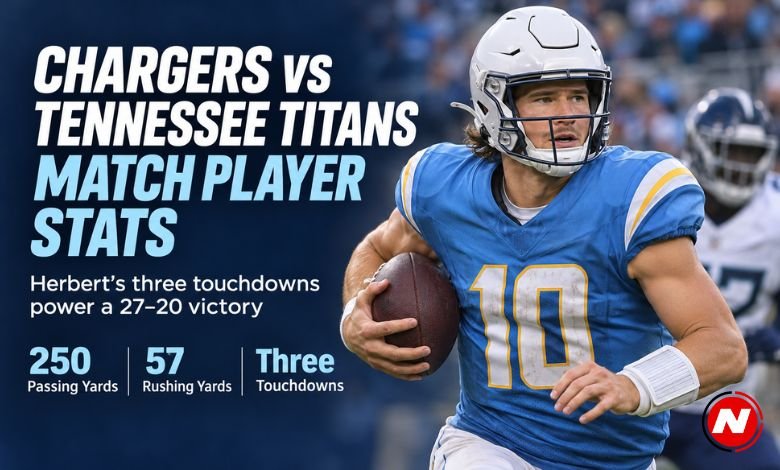
Yet the Chargers vs Tennessee Titans Match Player Stats reveal how Los Angeles recovered to win 27–20 at Nissan Stadium on 2 November 2025. Herbert contributed through the air and on the ground, while his defence delivered a crucial stand near its own end zone.
The Week 9 victory moved the Chargers to 6–3 in the 2025 NFL season. Tennessee slipped to 1–8 despite an energetic defensive display.
The final score suggests a tight contest. Looking at the passing figures, rushing contributions and scoring plays explains why the Chargers eventually took control.
Match Overview: Early Drama Gives Way to a Chargers Recovery
Tennessee made the first major statement through Cody Barton, who intercepted Herbert and returned the ball 24 yards for a touchdown.
Los Angeles answered with a two-yard touchdown pass to Scott Matlock. However, the Titans regained their advantage when Chimere Dike raced 67 yards on a punt return, making the score 14–7.
That opening quarter created an unusual picture: Tennessee had two touchdowns without its offence reaching the end zone.
The Chargers settled during the second quarter. Cameron Dicker converted a 27-yard field goal, and Herbert connected with Quentin Johnston for a 19-yard touchdown.
Joey Slye’s 49-yard field goal brought Tennessee level before Dicker struck from 52 yards to give Los Angeles a 20–17 half-time lead.
Herbert’s fourth-quarter rushing touchdown later stretched the advantage. Slye reduced the deficit with another field goal, but Tennessee could not complete the comeback.
| Match detail | Result |
|---|---|
| Date | 2 November 2025 |
| Competition | 2025 NFL season, Week 9 |
| Venue | Nissan Stadium, Nashville |
| Final score | Los Angeles Chargers 27–20 Tennessee Titans |
| Chargers record after game | 6–3 |
| Titans record after game | 1–8 |
Chargers vs Tennessee Titans Match Player Stats: Passing Performance
Justin Herbert’s passing stats show how effectively he recovered from the early interception. He completed 19 of 29 attempts for 250 yards, throwing two touchdown passes and finishing with a 101.2 passer rating.
His performance came under considerable pressure. Tennessee recorded six sacks against him, repeatedly forcing Los Angeles to recover lost ground.
Herbert still found enough opportunities downfield to keep the attack moving. His touchdown throws to Matlock and Johnston helped turn an uncomfortable start into a half-time advantage.
Cam Ward completed 12 of 21 passes for 145 yards. He avoided an interception but finished without a touchdown pass and was sacked four times.
| Quarterback | Team | Completions/Attempts | Passing yards | TD | INT | Rating | Sacked |
|---|---|---|---|---|---|---|---|
| Justin Herbert | Chargers | 19/29 | 250 | 2 | 1 | 101.2 | 6 |
| Cam Ward | Titans | 12/21 | 145 | 0 | 0 | 78.5 | 4 |
The difference was more than the 105-yard gap between the quarterbacks. Herbert helped finish scoring opportunities, while Tennessee’s passing attack could not produce a touchdown.
Ward’s interception-free performance prevented another possible setback. However, with the Titans struggling to extend possessions, they needed more than avoiding turnovers to overturn the Chargers’ lead.
Rushing Stats: Herbert’s Legs Made the Difference
Herbert also finished as the Chargers’ leading rusher, gaining 57 yards on nine carries. His longest run covered 29 yards, while his one-yard touchdown early in the fourth quarter provided a valuable cushion.
That mobility added another problem for Tennessee’s defence. Even when the pass rush disrupted the play, Herbert could still threaten to gain ground himself.
Jaret Patterson offered useful support with 44 yards from nine attempts. Kimani Vidal carried 12 times for 30 yards, finding fewer openings against the Titans’ front.
| Player | Team | Carries | Rushing yards | Average | Longest run | TD |
|---|---|---|---|---|---|---|
| Justin Herbert | Chargers | 9 | 57 | 6.3 | 29 | 1 |
| Tony Pollard | Titans | 10 | 56 | 5.6 | 16 | 0 |
| Jaret Patterson | Chargers | 9 | 44 | 4.9 | 9 | 0 |
| Kimani Vidal | Chargers | 12 | 30 | 2.5 | 7 | 0 |
| Tyjae Spears | Titans | 7 | 26 | 3.7 | 10 | 0 |
| Cam Ward | Titans | 2 | 6 | 3.0 | 6 | 0 |
Tony Pollard’s rushing performance was encouraging in terms of yardage. He averaged 5.6 yards per carry and finished just one yard behind Herbert.
However, Tennessee’s ground game could not deliver a touchdown. The Titans gained 88 rushing yards overall, compared with the Chargers’ 131.
The biggest difference came close to the goal line, where Los Angeles converted its opportunity and Tennessee was stopped.
Receiving Stats: Gadsden Leads, Johnston Supplies the Touchdown
The receiving figures in the Chargers vs Tennessee Titans Match Player Stats highlight the range of options available to Herbert.
Oronde Gadsden II led the Chargers with five receptions for 68 yards. His 34-yard catch was the longest reception by either team.
Ladd McConkey contributed 56 yards from four catches, while Quentin Johnston added 53 yards and a touchdown on four receptions.
Keenan Allen made only two catches, but his 41 yards included a 31-yard gain. It was a reminder that a receiver does not need a high catch total to make an important contribution.
| Receiver | Team | Catches | Receiving yards | Longest catch | TD |
|---|---|---|---|---|---|
| Oronde Gadsden II | Chargers | 5 | 68 | 34 | 0 |
| Ladd McConkey | Chargers | 4 | 56 | 21 | 0 |
| Quentin Johnston | Chargers | 4 | 53 | 23 | 1 |
| Elic Ayomanor | Titans | 3 | 46 | 29 | 0 |
| Keenan Allen | Chargers | 2 | 41 | 31 | 0 |
| Tyjae Spears | Titans | 3 | 36 | 26 | 0 |
| Van Jefferson | Titans | 1 | 21 | 21 | 0 |
| Tre Harris | Chargers | 2 | 18 | 15 | 0 |
| Gunnar Helm | Titans | 1 | 15 | 15 | 0 |
| Tucker Fisk | Chargers | 1 | 12 | 12 | 0 |
| Tony Pollard | Titans | 1 | 12 | 12 | 0 |
| Chigoziem Okonkwo | Titans | 2 | 10 | 6 | 0 |
| Chimere Dike | Titans | 1 | 5 | 5 | 0 |
| Scott Matlock | Chargers | 1 | 2 | 2 | 1 |
For Tennessee, Elic Ayomanor led the way with three catches for 46 yards. Tyjae Spears added 36 receiving yards to his 26 rushing yards, giving him 62 yards from scrimmage.
Matlock’s contribution was small in yardage but valuable on the scoreboard. His only catch produced a touchdown, showing why receiving totals need to be read alongside scoring impact.
Defensive Leaders and the Turning Point
Tennessee’s defence gave Los Angeles a difficult afternoon. Cedric Gray recorded 16 combined defensive tackles, including 11 solo stops, and added a sack.
Jihad Ward supplied 2.5 sacks, while Barton’s interception return delivered the Titans’ opening touchdown.
For the Chargers, Odafe Oweh produced two sacks and two tackles for loss. Daiyan Henley contributed a sack and seven defensive tackles, plus two tackles on special teams.
| Player | Team | Combined defensive tackles | Sacks | Tackles for loss | Interceptions |
|---|---|---|---|---|---|
| Cedric Gray | Titans | 16 | 1 | 1 | 0 |
| Jihad Ward | Titans | 4 | 2.5 | 2 | 0 |
| Cody Barton | Titans | 6 | 0 | 0 | 1 |
| Daiyan Henley | Chargers | 7 | 1 | 1 | 0 |
| Odafe Oweh | Chargers | 3 | 2 | 2 | 0 |
The decisive sequence arrived with Los Angeles leading 20–17 in the third quarter. Tennessee reached the Chargers’ one-yard line but failed to score.
Khalil Mack stopped Pollard on third down. Elijah Molden and Denzel Perryman then combined to deny him on fourth down.
Los Angeles followed that stand with a 15-play, 99-yard touchdown drive, finished by Herbert’s one-yard run.
The wider Chargers vs Tennessee Titans Match Player Stats underline how important sustained possessions became.
| Team statistic | Chargers | Titans |
|---|---|---|
| Total net yards | 343 | 206 |
| Net passing yards | 212 | 118 |
| Rushing yards | 131 | 88 |
| Offensive plays | 65 | 44 |
| Third-down conversions | 7/13 | 1/9 |
| Time of possession | 34:20 | 25:40 |
| Penalties | 3 | 7 |
| Penalty yards | 20 | 60 |
Net passing yards subtract yardage lost on sacks, which explains why these totals are lower than the quarterbacks’ individual passing figures.
Tennessee’s one successful third-down conversion from nine attempts limited its attacking opportunities. Its defence and special teams kept the score close, but the offence finished with only two field goals.
Conclusion
The Chargers vs Tennessee Titans Match Player Stats show a contest shaped by contrasting strengths. Tennessee created explosive return touchdowns and consistent pressure, while Los Angeles found more reliable offensive production.
Herbert’s passing, rushing and response to an early mistake proved central. Gadsden led the receiving effort, Johnston supplied a touchdown catch, and the Chargers’ goal-line defence protected a narrow lead.
The game turned on two connected moments: Tennessee’s failed attempt to score from close range and the Chargers’ long touchdown drive immediately afterwards.
(FAQs)
Who won the Chargers against Titans game on 2 November 2025?
The Los Angeles Chargers won 27–20 at Nissan Stadium in Week 9 of the 2025 NFL season.
How many touchdowns did Justin Herbert score or throw?
Herbert threw two touchdown passes and scored one rushing touchdown, accounting for all three Chargers touchdowns.
Who had the most receiving yards?
Oronde Gadsden II led all receivers with 68 yards. Elic Ayomanor was Tennessee’s leading receiver with 46 yards.
How did Tennessee score its touchdowns?
Cody Barton scored on a 24-yard interception return. Chimere Dike added a 67-yard punt-return touchdown.
Why did the Chargers win despite allowing six sacks?
Herbert produced three total touchdowns, and the defence prevented Tennessee from scoring an offensive touchdown. The Chargers also controlled possession and converted third downs more effectively.