Denver Nuggets vs Timberwolves Match Player Stats: What Decided Minnesota’s 110–98 Playoff Win?

A big night from Nikola Jokić was not enough to save Denver. With their season on the line, the Nuggets ran into a Minnesota team that found scoring from unexpected places and kept winning the battle for extra possessions.
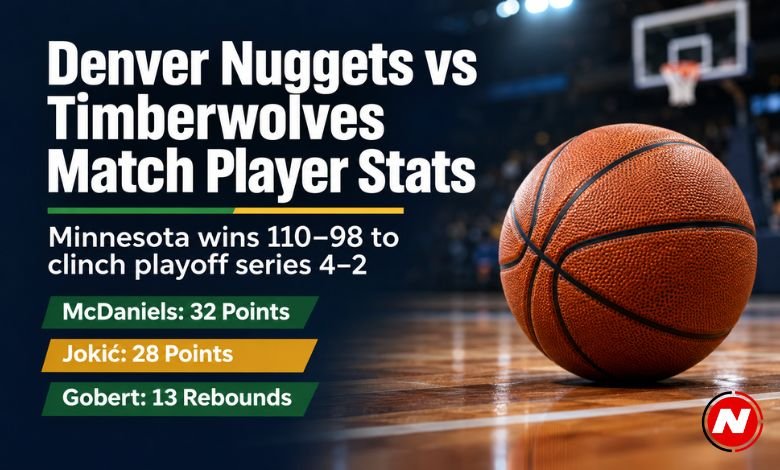
The denver nuggets vs timberwolves match player stats explain how the Timberwolves secured a 110–98 victory at Target Center on 30 April 2026. Minnesota closed the first-round playoff series 4–2, with Jaden McDaniels leading the scoring and Terrence Shannon Jr. providing crucial support.
Denver had its own standout performances, particularly from Jokić and Cameron Johnson. However, Minnesota’s rebounding, inside scoring and balanced contributions proved stronger than the visitors’ individual efforts. Here is how the main performances shaped the result.
Minnesota Took Control After a Competitive Opening
Denver finished the first quarter with a 30–29 lead. It was a promising start for a team needing victory to keep the series alive, but the advantage did not survive the next period.
Minnesota outscored the Nuggets 28–20 in the second quarter, moving into a 57–50 half-time lead. That seven-point cushion gave the home side some breathing room without putting the game beyond Denver’s reach.
The third quarter remained competitive. Minnesota scored 25 points to Denver’s 24, leaving the Timberwolves ahead 82–74 with one period remaining. They then won the fourth quarter 28–24 to complete the victory.
The Denver Nuggets vs Timberwolves match player stats show a contest settled through steady gains. Minnesota won each of the final three quarters, preventing Denver from putting together a period strong enough to reverse the direction of the game.
The Timberwolves also had to manage significant absences. Anthony Edwards and Donte DiVincenzo were inactive, while Ayo Dosunmu missed the game with right calf soreness. Denver was without Aaron Gordon because of left calf tightness.
Those missing players increased the responsibility on everyone available. Minnesota responded with several meaningful contributions across its shortened rotation.
McDaniels and Shannon Turned Opportunity into Points
Jaden McDaniels delivered the game’s highest scoring total with 32 points, adding 10 rebounds in a performance that gave Minnesota both attacking production and strength on the boards.
He made 13 of 25 field-goal attempts and five of six free throws. Only one of his successful shots came from three-point range, meaning most of his baskets were scored inside the arc.
McDaniels also supplied three assists, two steals and one block. Perhaps just as valuable, he completed his heavy workload without a turnover.
His playing time reached 44 minutes and 54 seconds. Minnesota needed him for almost the entire contest, and he remained productive across several parts of the game.
Terrence Shannon Jr. gave the Timberwolves another major scoring option with 24 points. He added six rebounds, one assist and two steals while also avoiding a turnover.
Shannon shot nine for 20 from the field and made all five free throws. Although he connected on only one of seven three-point attempts, his scoring elsewhere kept his contribution substantial.
Together, McDaniels and Shannon produced 56 of Minnesota’s 110 points. Their combined total was particularly significant given the players missing from the backcourt.
The pair also finished with four steals between them. Their value extended beyond replacing lost scoring: they helped Minnesota compete for possessions while keeping their own mistakes low.
Denver’s Leading Scorers Needed More Support
Nikola Jokić came close to another triple-double, finishing with 28 points, 10 assists and nine rebounds.
He made 11 of his 19 shots, including one three-pointer, and converted five of six free throws. His scoring was efficient, while his passing continued to create opportunities for teammates.
Jokić spent 43 minutes and 24 seconds on court. That workload underlined Denver’s reliance on him as both a scorer and the centre of its attacking play.
Cameron Johnson was the Nuggets’ other major threat. He scored 27 points, collected eight rebounds and contributed three assists.
Johnson made five of 10 attempts from beyond the arc. Those five three-pointers accounted for half of Denver’s successful long-range shots and helped keep the visitors competitive.
Jamal Murray had a much harder evening. He finished with 12 points on four-for-17 shooting, missing both three-point attempts. He added six rebounds and four assists, but Denver needed greater scoring efficiency from one of its main attacking options.
The Denver Nuggets vs Timberwolves match player stats highlight that imbalance. Jokić and Johnson combined for 55 points, leaving the rest of the team to supply 43.
Tim Hardaway Jr. offered useful bench scoring with 13 points on four-for-seven shooting. Spencer Jones added eight points, while Tyus Jones recorded four points and three assists.
Christian Braun scored three points and blocked three shots. Bruce Brown contributed one point and two steals, and Zeke Nnaji finished without scoring.
Jonas Valančiūnas completed Denver’s scoring with two points in 3:43. His contribution belongs in the full box score, bringing the player totals to the team’s final 98 points.
Gobert, Randle and Reid Kept Minnesota Balanced
Rudy Gobert’s scoring total was modest compared with the game’s leading performers, but his overall contribution was substantial.
He finished with 10 points, 13 rebounds, eight assists and two blocks. Seven of those rebounds came at the offensive end, giving Minnesota repeated chances to extend possessions.
Gobert also avoided committing a turnover. Producing eight assists without losing the ball was especially useful in a match where Minnesota had several guards unavailable.
His passing gave the Timberwolves another way to move the attack forward. His rebounding helped them recover when the first shot failed.
Julius Randle supplied 18 points, five assists and four rebounds. He made six of 17 shots, including two three-pointers, and added four points at the free-throw line.
Randle’s shooting was uneven, but his final contribution still gave Denver another scorer to account for.
Naz Reid added 15 points, seven rebounds and four assists from the bench. He made seven of 13 field-goal attempts, providing efficient scoring during his 33 minutes and 47 seconds on court.
Mike Conley contributed seven points, six rebounds and three assists. Jaylen Clark scored three points, and Bones Hyland added one.
Minnesota’s scoring therefore came from several directions. McDaniels and Shannon led the way, while the players around them supplied enough finishing, passing and rebounding to sustain the team’s advantage.
Extra Possessions Made the Biggest Difference
Shooting percentages alone do not fully explain this result.
Minnesota made 45.7% of its field-goal attempts, only slightly better than Denver’s 45.3%. The much larger difference was the number of attempts: 94 for the Timberwolves and 75 for the Nuggets.
That allowed Minnesota to finish with 43 successful field goals against Denver’s 34.
Rebounding played a major role. The Timberwolves collected 50 player rebounds, compared with the Nuggets’ 33. Their offensive rebounding advantage was particularly strong at 19–6.
Those recovered misses helped Minnesota generate 20 second-chance points, while Denver managed four. The Timberwolves also finished with a 64–40 advantage in points in the paint.
These figures explain why Denver’s better three-point shooting could not carry it through. The Nuggets made 10 of 27 attempts from distance, while Minnesota converted seven of 29.
Denver was also more accurate at the free-throw line, making 20 of 25. Minnesota finished 17 for 24.
However, those shooting advantages were outweighed by the Timberwolves’ volume of opportunities near the basket.
Turnovers added to the difference. Denver recorded 13, while Minnesota had seven player turnovers and one additional team turnover.
For readers examining the denver nuggets vs timberwolves match player stats, the central lesson is clear: similar shooting accuracy can produce different outcomes when one team creates far more chances to score.
Conclusion
The denver nuggets vs timberwolves match player stats show how Minnesota combined standout scoring with control of the boards to finish the series.
McDaniels and Shannon delivered the points, Gobert helped secure extra possessions, and Randle and Reid provided valuable support. Denver received strong performances from Jokić and Johnson, but could not overcome the wider gaps.
Minnesota earned its place in the next round by repeatedly giving itself another chance—and making enough of those chances count.
(FAQs)
What was the final score between Denver and Minnesota?
The Minnesota Timberwolves defeated the Denver Nuggets 110–98 at Target Center on 30 April 2026.
Who was the highest scorer in the game?
Jaden McDaniels led all scorers with 32 points. He also collected 10 rebounds and finished without a turnover.
How many points did Nikola Jokić score?
Jokić scored 28 points, alongside 10 assists and nine rebounds. He finished one rebound short of a triple-double.
What were Jamal Murray’s shooting numbers?
Murray made four of 17 field-goal attempts and missed both three-pointers. He converted all four free throws to finish with 12 points.
How did the result affect the playoff series?
The victory gave Minnesota a 4–2 series win, allowing the Timberwolves to advance and ending Denver’s playoff campaign.