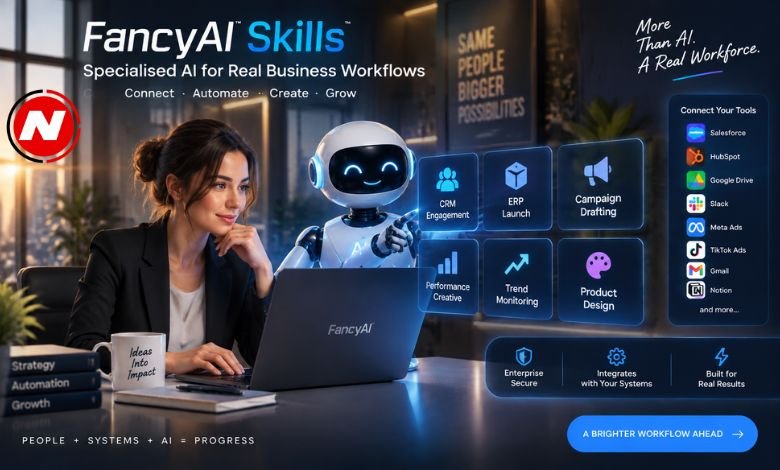
Artificial intelligence is moving into a new phase. Instead of simply answering questions or generating a piece of text, modern AI systems are increasingly being designed to complete practical tasks inside real business environments. FancyAI Skills are part of that shift, bringing specialised AI capabilities into workflows that businesses already use.
FancyAI describes its platform as an AI workforce for enterprise, designed to connect with systems including CRM, ERP, digital asset management (DAM), social channels and advertising platforms. The goal is to turn business information and existing assets into useful, ready-to-use outputs without forcing teams to rebuild their entire technology stack.
From customer engagement and product launches to campaign creation, trend monitoring and performance-focused advertising, the platform is built around specific jobs rather than one generic AI experience. That distinction could matter as companies look for ways to make AI more practical, connected and measurable.
What Are FancyAI Skills?
At its core, FancyAI Skills are specialised capabilities designed around defined business workflows. Rather than asking a general AI assistant to work out every step from scratch, companies can use skills focused on areas such as CRM workflows, ERP launches, campaign drafting, performance creative and product design.
The idea is relatively simple: connect AI to the information a company already has, then use that context to complete a meaningful task.
For example, a business could connect FancyAI to its CRM and use customer behaviour and sales information to identify churn signals or create personalised re-engagement campaigns. The platform says these workflows are designed to reduce manual data entry and help teams move from raw customer information to actionable creative work.
This task-focused model is one reason the platform uses the language of an AI workforce rather than simply describing itself as another chatbot. FancyAI says its AI employees are intended to adapt to enterprise systems and execute business objectives across multi-step processes.
How FancyAI Connects AI With Business Systems
One of the most important parts of FancyAI Skills is the connection between AI and existing company systems. FancyAI says its desktop product can integrate with local files as well as enterprise environments such as CRM, ERP and DAM platforms, along with social and advertising channels.
That connection creates several possible use cases.
With CRM integration, AI can work from customer records and interaction data. With ERP integration, a newly registered product can trigger the creation of launch materials, specification sheets and marketing visuals. A DAM connection can help teams locate and reuse approved brand assets instead of searching through files manually.
FancyAI also lists integrations with services and platforms including Salesforce, HubSpot, Meta Ads, TikTok Ads, Instagram, Slack, Gmail, Google Drive, Notion and Canva. The exact workflow available to a business can depend on its systems and setup.
The wider point is that AI becomes more useful when it has access to relevant context. Instead of creating an isolated output, it can potentially become part of the same chain of work that already includes data, approvals, assets and distribution.
From Product Launches to Performance Creative
The range of FancyAI Skills shows how the platform is targeting several stages of the commercial process.
Its ERP Launch capability is designed to respond when a new product enters an enterprise system. According to FancyAI, the skill can help generate launch assets, product visuals and specification materials from technical product information. That could reduce the gap between a product being registered internally and being prepared for promotion.
Campaign Drafting focuses on another familiar problem: turning an idea into a complete marketing package. FancyAI says this skill can create campaign briefs, copy angles, landing-page sections and advertising variations from a single prompt connected to business data.
Then there is Performance Creative, which takes a more data-led approach. The platform says winning advertising hooks and existing results can be used to create new creative variations for channels such as Meta and TikTok.
This is significant because producing more content is not necessarily the same as producing more useful content. A performance-focused workflow attempts to connect creative production with information about what has already worked.
Trend Monitoring, Product Design and the Desktop Workflow
Another part of FancyAI’s approach is bringing AI into areas where speed can influence commercial decisions.
The platform’s Trend Monitoring skill is designed to track social signals and turn emerging topics into brand-aligned captions, visuals and content plans. For marketing teams, that connects research with execution rather than treating trend analysis as a separate activity.
Product Design takes a different route. FancyAI says the skill can analyse best-selling aesthetics, study proven silhouettes and help develop new pattern directions. This positions AI as part of the creative development process rather than only as a writing or image-generation tool.
The desktop experience is equally important. FancyAI says users can work with local files and folders directly from their PC, while connecting those assets to enterprise systems. Its stated aim is to bring files, tools, business systems and AI agents into one workspace.
That approach could be particularly relevant for teams that spend significant time moving information between folders, applications and business platforms.
FancyAI AI Experts and the Bigger AI Workforce Idea
Alongside its individual skills, FancyAI offers specialised AI Experts for different professional functions. Its current platform highlights experts across areas including design, marketing, operations, analytics, organisation and IT.
These experts are presented as role-focused AI colleagues. Examples shown by FancyAI include experts working on e-commerce analysis, technical planning, API development, presentation structure, virtual influencer design and product imagery.
FancyAI also offers an API model for its AI Experts, allowing businesses to select specialised experts and connect their endpoints with existing workflows. Its product offering additionally includes AI desktop integration, forward-deployed engineering support, training data services and post-trained models.
This makes the wider platform more than a collection of isolated prompts. The company is positioning its technology around specialised roles, connected systems and multi-step execution.
Why Specialised AI Skills Matter for Businesses
The rise of specialised AI reflects a practical challenge facing companies: getting value from AI often requires more than access to a powerful model.
A generic model may be capable of writing copy, analysing information or generating images, but businesses also need context. They need the right customer records, approved assets, product details, brand guidelines and distribution channels. Integrating those elements is where workflow-focused systems can become useful.
FancyAI Skills are therefore aimed at the space between AI capability and business execution. The company’s stated model is to combine domain-specific AI employees with enterprise integrations, centralised management and autonomous, multi-step workflows.
FancyAI also highlights enterprise security features including data isolation, encryption, zero-retention policies and private VPC deployment options. These are company-stated features, so organisations considering the platform would still need to review the technical and contractual details for their own requirements.
The bigger story is not simply about automation. It is about changing where AI sits in the organisation. Instead of being a separate tool opened when someone needs help, AI is increasingly being designed to sit inside the workflow itself.
Conclusion
FancyAI Skills reflect a broader change in the way businesses are approaching artificial intelligence. The emphasis is shifting from one-off prompts and isolated content generation towards AI that can interact with company systems, understand specific workflows and help carry tasks through multiple stages.
FancyAI’s combination of specialised skills, AI Experts, enterprise integrations and desktop tools shows how that model is developing. From CRM engagement and product launches to advertising, trend monitoring and design, the focus is increasingly on turning AI capability into practical business execution.
The next chapter of workplace AI may not be about asking better questions. It may be about giving AI a role, the right context and a direct connection to the work that needs to be done.
(FAQs)
What are FancyAI Skills?
FancyAI Skills are specialised AI capabilities created for particular business workflows, including CRM engagement, ERP product launches, campaign drafting, performance creative, trend monitoring and product design.
Can FancyAI connect with CRM and ERP systems?
Yes. FancyAI says its platform can connect with enterprise systems such as CRM and ERP environments, allowing business data to support automated or AI-assisted workflows.
What is the FancyAI desktop experience?
FancyAI’s desktop product is designed to work with local files and folders while also connecting to enterprise systems and creative channels. The company positions it as a central workspace for business data, assets and AI agents.
What are FancyAI AI Experts?
AI Experts are specialised AI agents designed for particular professional roles and functions, with examples across design, marketing, operations, analytics and IT.
Can businesses use FancyAI through an API?
FancyAI currently offers API access for its specialised AI Experts, allowing businesses to integrate selected expert capabilities into their existing workflows.
What makes specialised AI different from a general chatbot?
A general chatbot is typically designed to handle a broad range of requests. Specialised AI is built around a defined role, business context or workflow, making it more focused on completing specific tasks using relevant data and systems.