A small machine moves across a kitchen floor, turns away from a chair and quietly continues cleaning. In a warehouse, another machine carries a heavy load from one aisle to the next. Neither looks like the silver robots shown in old films, yet both belong to the same technological story.
Ponas Robotas is a Lithuanian phrase meaning “Mr Robot” in English. It sounds like the name of a mechanical character, but it can also introduce a much wider conversation about robots and artificial intelligence. Machines are no longer limited to research laboratories or large factories. They are appearing in hospitals, classrooms, businesses and ordinary homes. Some make work safer, while others save time or provide useful assistance. Their growing presence is exciting, but it also leaves people asking who controls them, what information they collect and how far their role should go.
What Ponas Robotas Really Means
The phrase is made from two Lithuanian words. Ponas is a respectful way of addressing a man, similar to “Mr” or “Sir”. Robotas means “robot”. Put together, the words give a machine a polite, almost personal identity.
That friendly wording tells us something about how people react to technology. We often name objects that become part of our routine. Cars, virtual assistants and household devices are regularly given nicknames. A name makes an unfamiliar machine feel easier to approach.
Robot designers understand this behaviour. Some machines have voices, screens or eye-like lights because these features make their actions easier to follow. A delivery robot that flashes a light before turning is easier to understand than one that suddenly changes direction without warning.
However, a human appearance can also create false expectations. A machine may speak clearly without understanding a conversation in the way a person does. It can produce a polite reply while completely missing the meaning of a question.
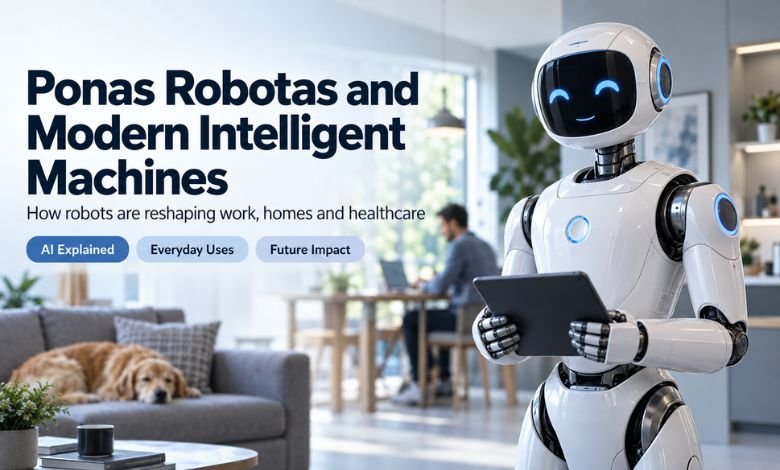
For that reason, Ponas Robotas should be understood as a useful image rather than proof of human-like intelligence. Behind the friendly name is a system of sensors, motors, computer code and stored data.
Robots Have Quietly Entered Daily Life
Many people still picture a robot as a metal figure with arms, legs and a mechanical voice. Real robots are usually less dramatic. Most are designed around one job, and their shape depends on what that job requires.
An industrial robot, for example, may be nothing more than a powerful moving arm. It can weld a vehicle body, lift heavy components or place hundreds of identical items into boxes. It does not need a face because it was built for accuracy rather than conversation.
Factories adopted such machines because repeated physical work can be tiring and dangerous. A robot can perform the same movement for hours, provided that its equipment is maintained and its working area remains controlled.
Warehouses use a different kind of machine. Low, wheeled robots can carry shelves or packages across large buildings. Workers no longer need to walk the same long routes throughout a shift. Instead, they can prepare orders, check stock and deal with problems that require human judgement.
Robots are also appearing on farms. Some systems inspect plants with cameras, while others help remove weeds or monitor field conditions. These machines can give farmers more detailed information about crops without treating every part of a field in exactly the same way.
In hospitals, the work is more sensitive. Robots may transport linen, medicine or equipment between departments. Rehabilitation devices can help patients repeat controlled movements after an injury. Surgical systems can support a trained medical team during delicate procedures.
The word “support” matters. A medical robot does not carry moral responsibility for a patient. Doctors, nurses and healthcare organisations remain responsible for deciding how and when the equipment should be used.
At home, robotic vacuum cleaners have made the technology feel ordinary. People set a schedule, leave the device to clean and step in when it becomes stuck under a table. The relationship is practical rather than futuristic: the machine handles one routine job, but the owner still manages it.
Intelligence Does Not Mean Human Thinking
A robot and an artificial intelligence system are not automatically the same thing. A robot is a physical machine that can act in the real world. Artificial intelligence is usually software that identifies patterns, processes language or selects a response.
Some robots work without advanced AI. A factory arm may repeat a programmed movement every few seconds. If an object is placed in the wrong position, the machine might stop or continue incorrectly because it cannot understand what has changed.
Adding cameras, sensors and intelligent software can make the machine more flexible. It may recognise the position of an object, notice an obstacle or select a different route. This ability is useful, but it is still limited by the information the system receives.
Imagine a service robot carrying meals through a hotel. Its sensors help it avoid walls and people. Its map shows where each room is located. If a suitcase blocks the corridor, the robot may slow down and move around it.
That looks like a decision, but the machine is not worried about arriving late. It is calculating a response according to its programming and the information from its sensors. It does not experience the journey as a human worker would.
Language systems can make this difference harder to notice. A machine may answer questions smoothly, remember a recent instruction or use a friendly tone. People can easily assume that it understands more than it actually does.
This is one of the central lessons behind Ponas Robotas. A natural voice and clever response should not be confused with awareness, emotion or reliable judgement. Even advanced systems can misunderstand instructions and give incorrect information.
Where Robots Help and Where Problems Begin
Robots are most valuable when they solve a clear problem. Sending a machine into a dangerous building, asking it to lift heavy materials or using it to inspect a narrow pipe can reduce risks for workers.
They can also improve consistency. A properly set-up machine does not become bored halfway through a repetitive task. It can measure, cut or position materials in the same way each time.
For people with limited mobility, robotic equipment may offer greater independence. A device could carry objects, support movement or provide reminders. These features may seem small, but they can make everyday routines easier.
The benefits are real, although they do not remove the risks. Machines break down. Batteries lose power, sensors become dirty and software develops faults. A robot that works perfectly in a demonstration may struggle in a busy room where children, pets and furniture keep moving.
Privacy creates another problem. A machine that navigates with cameras may record details about the people and places around it. A voice-controlled device may need to process spoken instructions. Owners should know what is collected and whether that information is stored or shared.
Security is equally important. A connected robot can become vulnerable if its software is not protected. Weak passwords and missed updates may give an unauthorised person access to the system.
Employment is often the most emotional part of the debate. Automation can reduce the demand for certain repetitive roles. For someone whose job is affected, promises about future innovation offer little comfort unless retraining and real opportunities are available.
At the same time, robots create new responsibilities. People are needed to install equipment, inspect its work, repair faults and investigate safety problems. The nature of employment changes, but the transition is not always simple or fair.
Human control therefore remains essential. An automated recommendation should not become a final answer simply because it came from a computer. This is especially important in healthcare, education, recruitment and other areas where a mistake can affect someone’s future.
The Next Generation Will Look More Practical Than Dramatic
The future robot may not walk through the front door and hold a full conversation. It is more likely to be a specialised machine quietly completing one useful job.
In cities, small robots could deliver items across short distances. Hospitals may use more automated equipment to move supplies. Farms could adopt machines that inspect individual plants rather than treating an entire field in the same way.
Homes may also contain more smart machines, although price and usefulness will decide what succeeds. People will not keep an expensive robot simply because it looks impressive. It must save time, work reliably and be easy to control.
Good design will become as important as technical power. A machine operating near people should make its movements clear. Users should be able to stop it quickly and understand when something has gone wrong.
Developers will also have to design for real homes and workplaces, not perfect testing rooms. Stairs, poor lighting, noise, changing layouts and unexpected objects can all confuse a system.
This practical approach gives Ponas Robotas a more believable future. The goal is not to create a machine that pretends to be a person. It is to build technology that completes a useful task while respecting human safety, privacy and choice.
Conclusion
Ponas Robotas sounds like the name of a polite mechanical companion, but its wider meaning belongs to the real world. Robots already move products, inspect crops, support medical teams and complete household tasks.
Their value should be judged by what they genuinely improve. A useful machine can reduce danger, save time and support people without pretending to replace human intelligence.
The future of robotics will not depend only on faster processors or smarter software. It will depend on honest design, strong safety standards and people who know when to trust a machine and when to switch it off.
(FAQs)
What does Ponas Robotas mean in English?
The phrase means “Mr Robot”. It comes from Lithuanian, where ponas is a respectful title and robotas means “robot”.
Does the phrase describe a particular machine?
Not necessarily. It can be used as a name or title, but it may also refer more generally to robots and intelligent technology.
Are all robots controlled by artificial intelligence?
No. Many robots follow fixed instructions. Artificial intelligence is used when a machine needs to recognise patterns, understand language or respond to changing conditions.
Can a robot understand human emotions?
A system may identify certain words, expressions or tones, but that is not the same as feeling an emotion. Its response is produced through data and programming.
Why are robots used in dangerous workplaces?
They can enter unsafe areas, lift heavy objects and handle harmful materials. This can reduce the physical risks faced by human workers.
Will every home have a humanoid robot?
That remains unlikely in the near future. Specialised devices for cleaning, security or mobility are more practical and affordable than one human-shaped machine designed to do everything.