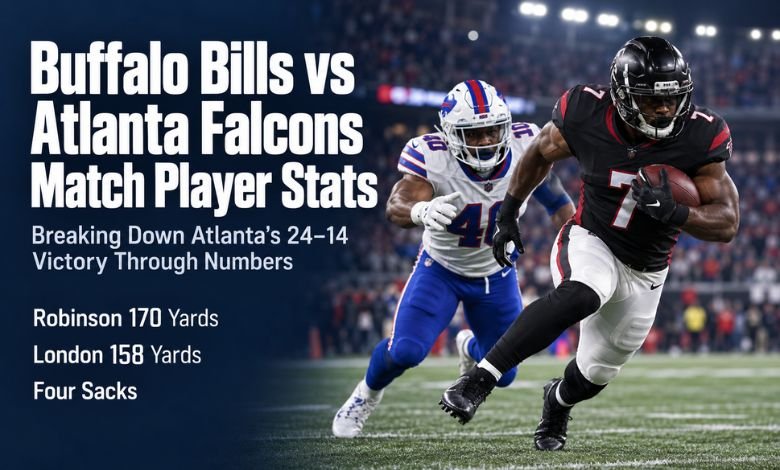
The Buffalo Bills vs Atlanta Falcons match player stats tell the story of a surprising night in Atlanta. The Falcons defeated the Bills 24–14 on 13 October 2025 at Mercedes-Benz Stadium, with Bijan Robinson and Drake London delivering two of the game’s biggest performances.
Robinson rushed for 170 yards, including a stunning 81-yard touchdown, while London caught 10 passes for 158 yards. Quarterback Michael Penix Jr also played an important part, throwing for 250 yards without an interception.
For Buffalo, Josh Allen threw two touchdown passes but was intercepted twice. James Cook added 87 rushing yards, although the Bills struggled to keep their offence moving when it mattered most.
Atlanta finished with 443 total net yards compared with Buffalo’s 291, showing the difference between the two teams. Here is a closer look at the final score, player statistics, team performances and moments that decided the game.
Buffalo Bills vs Atlanta Falcons Final Score
The Falcons took control during the first half, scoring three touchdowns before the break. Buffalo fought back in the third quarter but could not find another touchdown.
Final Score: Atlanta Falcons 24, Buffalo Bills 14
| Quarter | Buffalo Bills | Atlanta Falcons |
|---|---|---|
| First Quarter | 7 | 14 |
| Second Quarter | 0 | 7 |
| Third Quarter | 7 | 0 |
| Fourth Quarter | 0 | 3 |
| Final Score | 14 | 24 |
The result moved Atlanta to a 3–2 record, while Buffalo dropped to 4–2 during Week 6 of the 2025 NFL season.
Buffalo Bills vs Atlanta Falcons Team Stats Comparison
Atlanta’s advantage went beyond the final score. The Falcons gained more yards, earned more first downs and protected the football better than their opponents.
| Team Statistics | Buffalo Bills | Atlanta Falcons |
|---|---|---|
| Total Net Yards | 291 | 443 |
| Total Offensive Plays | 54 | 66 |
| Net Passing Yards | 157 | 233 |
| Rushing Yards | 134 | 210 |
| First Downs | 17 | 22 |
| Third-Down Conversions | 2/9 | 5/12 |
| Fourth-Down Conversions | 0/1 | 0/1 |
| Turnovers | 2 | 0 |
| Sacks Allowed | 4 | 2 |
| Penalties | 8 | 6 |
| Penalty Yards | 64 | 35 |
| Time of Possession | 28:21 | 31:39 |
The most noticeable difference was Atlanta’s ability to produce big gains. The Falcons averaged 6.7 yards per offensive play, while Buffalo averaged 5.4.
Buffalo also struggled on third down, converting only two of nine attempts. Atlanta converted five of 12, giving its offence more chances to stay on the field.
The turnover battle was just as important. Atlanta committed no turnovers, while Buffalo lost possession through two interceptions.
Quarterback Stats: Josh Allen vs Michael Penix Jr
The quarterback contest was expected to play a major role in the result. Josh Allen entered the game as Buffalo’s main attacking threat, but Michael Penix Jr delivered the steadier performance.
| Passing Stats | Josh Allen | Michael Penix Jr |
|---|---|---|
| Completions | 15 | 20 |
| Attempts | 26 | 32 |
| Passing Yards | 180 | 250 |
| Passing TDs | 2 | 1 |
| Interceptions | 2 | 0 |
| Passer Rating | 72.6 | 97.1 |
| Times Sacked | 4 | 2 |
Josh Allen’s Performance
Allen completed 15 of his 26 passes for 180 yards and two touchdowns. His scoring throws went to Dawson Knox and Ray Davis, giving Buffalo hope at different points in the game.
He also rushed six times for 42 yards, including a 24-yard run. His ability to move outside the pocket helped Buffalo gain ground when passing options were limited.
However, Atlanta’s defence kept him under pressure. The Falcons recorded four sacks and intercepted him twice.
Dee Alford made the first interception shortly before half-time, while DeAngelo Malone secured the second in the closing seconds. Those mistakes prevented Buffalo from building a serious comeback.
Michael Penix Jr’s Performance
Penix completed 20 of 32 passes for 250 yards and one touchdown. He did not throw an interception and finished with an impressive 97.1 passer rating.
His strongest partnership was with Drake London. The receiver consistently found space, allowing Penix to complete important passes and extend Atlanta’s drives.
Penix also benefited from Atlanta’s running attack. With Buffalo forced to respect Robinson’s speed, the quarterback had opportunities to attack through the air.
He was sacked twice, but his control of possession helped Atlanta stay ahead throughout the second half.
Buffalo Bills vs Atlanta Falcons Rushing Player Stats
The rushing battle was one of the clearest reasons Atlanta won. Bijan Robinson delivered the standout performance, combining explosive speed with the ability to gain yards after contact.
| Player | Team | Carries | Yards | TDs |
|---|---|---|---|---|
| Bijan Robinson | Falcons | 19 | 170 | 1 |
| Tyler Allgeier | Falcons | 10 | 32 | 1 |
| Michael Penix Jr | Falcons | 2 | 6 | 0 |
| Feleipe Franks | Falcons | 1 | 2 | 0 |
| James Cook | Bills | 17 | 87 | 0 |
| Josh Allen | Bills | 6 | 42 | 0 |
| Ty Johnson | Bills | 1 | 5 | 0 |
Bijan Robinson’s 81-Yard Touchdown
Robinson’s biggest moment arrived early in the second quarter. He broke through Buffalo’s defence and raced 81 yards for a touchdown, extending Atlanta’s lead to 21–7.
That run was more than a highlight. It gave the Falcons a two-touchdown advantage and forced Buffalo to chase the game.
Robinson finished with 170 rushing yards on 19 carries, averaging 8.9 yards per attempt. He also caught six passes for another 68 yards.
His combined total of 238 yards from scrimmage made him the most productive attacking player on the field.
James Cook’s Effort for Buffalo
James Cook was Buffalo’s leading runner with 87 yards from 17 carries. He averaged 5.1 yards per attempt and produced several useful gains.
Cook showed that Buffalo could move the ball on the ground, but the team could not maintain enough attacking pressure.
As Atlanta protected its lead, the Bills increasingly depended on Allen’s passing. That made it easier for the Falcons to bring pressure against the quarterback.
Buffalo Bills vs Atlanta Falcons Receiving Stats
Atlanta’s receiving attack was led by Drake London, who finished well ahead of every other receiver in the game.
| Player | Team | Receptions | Yards | TDs |
|---|---|---|---|---|
| Drake London | Falcons | 10 | 158 | 1 |
| Bijan Robinson | Falcons | 6 | 68 | 0 |
| Kyle Pitts | Falcons | 3 | 18 | 0 |
| Tyler Allgeier | Falcons | 1 | 6 | 0 |
| Joshua Palmer | Bills | 2 | 60 | 0 |
| Khalil Shakir | Bills | 3 | 33 | 0 |
| Tyrell Shavers | Bills | 3 | 27 | 0 |
| Dawson Knox | Bills | 1 | 19 | 1 |
| Ray Davis | Bills | 2 | 19 | 1 |
| Keon Coleman | Bills | 3 | 11 | 0 |
Drake London Dominates the Receiving Battle
London caught 10 of his 16 targets for 158 yards and one touchdown. His longest reception covered 39 yards.
His touchdown came late in the first quarter when Penix found him for a nine-yard score, putting Atlanta ahead 14–7.
London was particularly effective when Atlanta needed to move the chains. His ability to create separation and secure difficult catches kept Buffalo’s secondary under pressure.
Together, London and Robinson accounted for 226 of Penix’s 250 passing yards.
Buffalo’s Receiving Performance
Joshua Palmer led Buffalo with 60 receiving yards from only two catches. His longest reception gained 45 yards, providing one of the Bills’ few major passing plays.
Khalil Shakir contributed 33 yards, while Tyrell Shavers added 27. Dawson Knox and Ray Davis scored Buffalo’s two receiving touchdowns.
Keon Coleman had a difficult outing, catching three of six targets for just 11 yards.
Buffalo had several players involved in the passing attack, but none matched London’s consistent impact.
Defensive Player Stats and Key Turnovers
Atlanta’s defence played an important role in protecting the lead. The Falcons pressured Allen, stopped important drives and made two interceptions.
| Player | Team | Tackles | Sacks | INT |
|---|---|---|---|---|
| Dee Alford | Falcons | 6 | 1 | 1 |
| Mike Hughes | Falcons | 6 | 0 | 0 |
| David Onyemata | Falcons | 4 | 1 | 0 |
| Sam Roberts | Falcons | 4 | 1 | 0 |
| Ruke Orhorhoro | Falcons | 2 | 1 | 0 |
| DeAngelo Malone | Falcons | 0 | 0 | 1 |
| Shaq Thompson | Bills | 10 | 0 | 0 |
| Taylor Rapp | Bills | 7 | 0 | 0 |
| Ed Oliver | Bills | 3 | 1 | 0 |
| Javon Solomon | Bills | 1 | 1 | 0 |
Tackle figures in this table refer to combined regular defensive tackles.
Dee Alford Makes the Difference
Alford was one of Atlanta’s most influential defensive players. He finished with six combined tackles, one sack, three passes defended and an interception.
His interception near the end of the first half removed a possible scoring opportunity for Buffalo.
Atlanta also received sacks from Onyemata, Roberts and Orhorhoro. The pressure kept Allen from finding a comfortable passing rhythm.
Malone added the final interception with about 40 seconds remaining, ending Buffalo’s last attempt to score.
Buffalo’s Defensive Efforts
Shaq Thompson led Buffalo with 10 combined tackles, while Taylor Rapp recorded seven.
Ed Oliver and Javon Solomon each registered a sack. Oliver also had two tackles for loss.
Deone Walker made five combined defensive tackles and recorded four quarterback hits. He was active around the line of scrimmage, although Atlanta still finished with 210 rushing yards.
Buffalo had individual defensive successes, but Robinson’s big gains and London’s receptions proved difficult to contain.
Key Moments That Decided the Bills vs Falcons Game
First Quarter: Both Teams Find the End Zone
Atlanta scored on its opening drive when Tyler Allgeier ran 21 yards for a touchdown.
Buffalo responded with a 19-yard touchdown pass from Allen to Dawson Knox, bringing the score level at 7–7.
The Falcons regained the lead when Penix connected with London for a nine-yard touchdown. Atlanta ended the first quarter ahead 14–7.
Second Quarter: Robinson Changes the Game
The biggest play of the evening came with 11:09 remaining in the second quarter.
Robinson burst through the Bills’ defence and completed an 81-yard touchdown run, sending Atlanta into a 21–7 lead.
Buffalo could not score before the break, leaving Allen and his teammates facing a difficult second half.
Third Quarter: Buffalo Fights Back
The Bills began the second half with a stronger attacking drive.
Allen completed a 16-yard touchdown pass to Ray Davis, reducing Atlanta’s lead to 21–14.
Buffalo’s defence then created opportunities to keep the contest close. However, the offence could not find the touchdown needed to draw level.
Fourth Quarter: Atlanta Secures the Win
Buffalo entered the final quarter still trailing by seven points.
Atlanta’s defence prevented the Bills from scoring, while the Falcons put together a long possession that ended with Parker Romo’s 33-yard field goal.
That kick extended the lead to 24–14 with 1:43 remaining.
Buffalo attempted one final drive, but Malone intercepted Allen to settle the result.
Why Did the Atlanta Falcons Beat the Buffalo Bills?
Atlanta’s victory came from a combination of strong rushing, reliable receiving and better ball security.
Robinson gave the Falcons their biggest advantage. His 170 rushing yards forced Buffalo to worry about the ground attack, while his six receptions made him dangerous in passing situations as well.
London provided the other major threat. His 158 receiving yards allowed Penix to move the offence forward, particularly when Atlanta needed important completions.
The Falcons also handled pressure more effectively. Penix avoided interceptions, while Allen was picked off twice and sacked four times.
Buffalo’s third-down performance was another problem. Converting just two of nine opportunities made it difficult to sustain drives.
Atlanta did not dominate every area of the game. Buffalo managed to cut the lead to seven points in the third quarter, and the Falcons finished with only one touchdown from three red-zone visits.
Even so, Atlanta made better use of its biggest opportunities. Its 152-yard advantage in total net offence showed how much more productive the Falcons were across the game.
Conclusion
The Buffalo Bills vs Atlanta Falcons match player stats show why Atlanta earned its 24–14 victory. The Falcons controlled the rushing battle, produced the biggest plays and avoided the turnovers that hurt Buffalo.
Bijan Robinson was the standout performer with 238 yards from scrimmage, while Drake London’s 158 receiving yards gave Atlanta another major advantage. Michael Penix Jr added a composed performance at quarterback.
Buffalo showed signs of a comeback after Allen’s third-quarter touchdown pass, but its attack could not finish the job.
For the Falcons, the victory was built on taking chances and protecting the football. For the Bills, it was a reminder that even a talented offence can struggle when sacks, interceptions and missed opportunities begin to add up.
(FAQs)
Who won the Buffalo Bills vs Atlanta Falcons game?
The Atlanta Falcons defeated the Buffalo Bills 24–14 on 13 October 2025 at Mercedes-Benz Stadium in Atlanta.
What were Josh Allen’s stats against the Falcons?
Josh Allen completed 15 of 26 passes for 180 yards, two touchdowns and two interceptions. He also rushed for 42 yards on six carries.
How many rushing yards did Bijan Robinson record?
Bijan Robinson recorded 170 rushing yards on 19 carries, including an 81-yard touchdown. He also contributed 68 receiving yards, finishing with 238 yards from scrimmage.
How did Michael Penix Jr perform against Buffalo?
Michael Penix Jr completed 20 of 32 passes for 250 yards, one touchdown and no interceptions. He finished with a passer rating of 97.1.
Who had the most receiving yards in the Bills vs Falcons game?
Drake London led all players with 158 receiving yards from 10 catches. He also scored one touchdown for Atlanta.
How many total yards did the Falcons gain?
The Falcons recorded 443 total net offensive yards, including 210 rushing yards and 233 net passing yards. Buffalo finished with 291 total net yards.