Buffalo Bills vs Atlanta Falcons Match Player Stats: The Numbers Behind Atlanta’s 24–14 Win

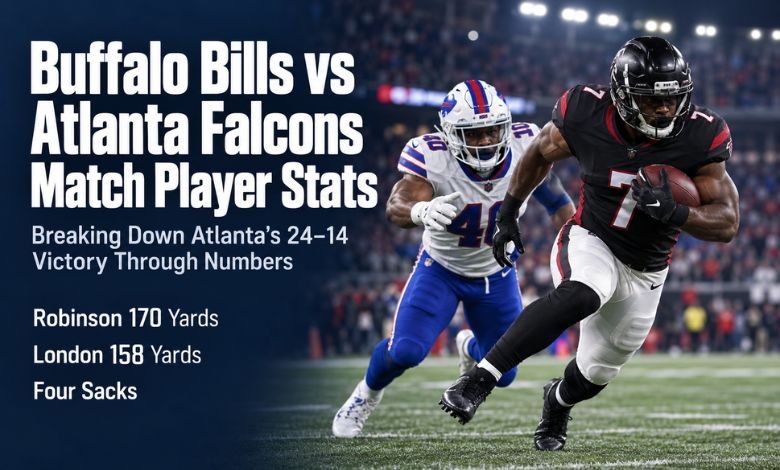
One long run changed the mood inside Mercedes-Benz Stadium. The Buffalo Bills arrived with Josh Allen leading their offence, but the Atlanta Falcons had the sharper night and won 24–14 on 13 October 2025. Atlanta built an early lead, stayed calm when Buffalo responded and protected its advantage in the closing stages.
The Buffalo Bills vs Atlanta Falcons match player stats explain why the Falcons came out on top. Bijan Robinson ran for 170 yards, Drake London collected 158 receiving yards and Michael Penix Jr avoided throwing an interception. Buffalo had some good moments through Allen and James Cook, but penalties, sacks and two costly turnovers slowed the team down. Atlanta finished with 443 net yards, while Buffalo managed 291.
How Atlanta Took Charge of the Game
Atlanta showed its plan on the first possession. The Falcons moved the ball quickly before Tyler Allgeier broke through for a 21-yard touchdown. Buffalo answered when Allen found Dawson Knox for a 19-yard score, making it 7–7.
The Falcons did not allow that reply to disturb them. Penix continued throwing towards London, who caused problems whenever he found room in the middle of the field. Their partnership produced Atlanta’s second touchdown and restored the home side’s seven-point lead.
Then came the play everyone remembered. Robinson slipped through a gap, escaped a tackle and ran 81 yards into the end zone. Buffalo’s defenders had little chance once he reached open space. Atlanta entered half-time with a 21–7 lead and complete control of the crowd.
Buffalo came back out with more purpose. Allen threw a 16-yard touchdown pass to Ray Davis in the third quarter, reducing the gap to seven points. It looked as if another Allen-led comeback might be starting, but Atlanta’s defence refused to bend.
The Bills failed to score again. A late field goal from Parker Romo moved Atlanta ten points ahead, and DeAngelo Malone’s interception ended Buffalo’s final hope.
Quarterback Numbers Show an Important Difference
The quarterback comparison was not simply about passing yards. Penix threw for more yards, but his careful handling of the ball mattered just as much.
He completed 20 of his 32 attempts for 250 yards and one touchdown. His passer rating was 97.1, and he did not commit a turnover. With Robinson keeping the defence worried about the run, Penix often had favourable situations in which to throw.
London was his first choice on many plays. Penix targeted him 16 times and regularly trusted him in tight coverage. The quarterback did not force the ball recklessly, however. When London was not available, Robinson provided another safe option underneath.
Allen completed 15 of 26 passes for 180 yards. He threw two touchdowns but was also intercepted twice, finishing with a passer rating of 72.6. He added 42 rushing yards from six attempts, including a 24-yard run.
Those rushing figures showed Allen’s ability to rescue a broken play. Still, he spent too much of the night trying to escape pressure. Atlanta sacked him four times and frequently sent extra defenders towards the pocket.
The first interception, made by Dee Alford, stopped Buffalo from creating more points before half-time. Malone collected the second near the end of the game. When looking at the Buffalo Bills vs Atlanta Falcons match player stats, that 0–2 difference in quarterback interceptions stands out immediately.
Bijan Robinson Produces the Performance of the Night
Robinson was the player Buffalo never managed to solve. He carried the ball 19 times for 170 yards, averaging 8.9 yards per attempt. His 81-yard touchdown was the biggest play, but his influence went far beyond that single run.
Atlanta also used him as a receiver. Robinson caught six of his eight targets for 68 yards, giving him 238 yards from scrimmage. A short pass could quickly become a large gain because of his balance and movement after the catch.
His receiving work also created a difficult choice for Buffalo’s linebackers. Moving closer to the line could leave space behind them, while dropping deeper gave Robinson room to run. Atlanta kept returning to this problem, and Buffalo never found a comfortable answer.
Allgeier played a smaller yet useful role. He finished with 32 yards from 10 carries and scored the opening touchdown. His direct running gave Robinson occasional breaks without forcing Atlanta to abandon its ground-based approach.
James Cook was Buffalo’s leading runner. He gained 87 yards on 17 carries and averaged 5.1 yards each time he took the ball. His longest run covered 14 yards.
Cook’s figures were good enough to suggest that Buffalo could have continued using him. Instead, his involvement became limited during the fourth quarter as the Bills chased the game through the air. That decision allowed Atlanta’s pass rush to focus more heavily on Allen.
The complete Bills vs Falcons stats show Atlanta finishing with 210 rushing yards from 32 attempts. Buffalo recorded 134 yards from 24 attempts. The gap did not come from a lack of effort by Cook; it came from Robinson producing the sort of explosive runs that can reshape an entire match.
Drake London Gives Buffalo Another Major Problem
While Buffalo tried to stop Robinson, London took control of the receiving contest. He caught 10 passes for 158 yards and one touchdown, averaging 15.8 yards per reception.
London’s longest catch covered 39 yards, but his value was not limited to deep throws. He found openings on important downs, used his frame to protect the ball and gave Penix a clear target when pressure arrived.
Robinson ranked second among Atlanta’s receivers with 68 yards. Kyle Pitts caught three passes for 18 yards, and Allgeier added one reception for six. Most of the passing attack flowed through London and Robinson, yet Buffalo still struggled to contain them.
Joshua Palmer led the Bills with 60 receiving yards from only two catches. One of those plays gained 45 yards, offering a brief sign that Buffalo could attack Atlanta downfield.
Khalil Shakir caught three passes for 33 yards, while Tyrell Shavers added three receptions for 27. Knox and Davis scored Buffalo’s touchdowns, with each recording 19 receiving yards.
Keon Coleman was targeted six times but made three catches for only 11 yards. Buffalo spread its passes among several players, but nobody found the steady rhythm that London enjoyed.
These receiving totals are an important part of the Buffalo Bills vs Atlanta Falcons match player stats. Atlanta had one receiver who repeatedly moved the offence forward. Buffalo had isolated gains without the same regular threat.
Atlanta’s Defence Wins the Crucial Moments
The Falcons did not completely shut down Allen, but they made sure he was rarely comfortable. Four Atlanta players recorded a sack: Alford, David Onyemata, Sam Roberts and Ruke Orhorhoro.
Alford had an especially busy evening. He made six total tackles, defended three passes, recorded one sack and intercepted Allen. Mike Hughes also finished with six tackles and broke up a pass.
Atlanta’s pressure had a clear effect on third down. Buffalo converted only two of nine third-down attempts. Several promising possessions ended before the Bills could move into scoring range.
Malone’s late interception was another example of Atlanta finishing a defensive job. Buffalo still had time on the clock, but the turnover removed any real chance of a final comeback.
Shaq Thompson was Buffalo’s leading tackler with 10 stops. Taylor Rapp made seven, while Dorian Williams and Cole Bishop recorded six each.
Ed Oliver and Tre’Davious White registered Buffalo’s two sacks. Deone Walker also worked hard near the line, making five tackles and four tackles for loss. These were useful individual efforts, but Atlanta’s offence continued finding ways to gain ground.
The Buffalo Bills vs Atlanta Falcons match player stats also show how costly Buffalo’s penalties became. The Bills were penalised eight times for 64 yards. Atlanta received six penalties for 35 yards. In a game where Buffalo already faced a two-score deficit, those lost yards made the comeback even harder.
| Player | Team | Main statistics |
|---|---|---|
| Michael Penix Jr | Falcons | 20/32 passing, 250 yards, 1 TD, 0 INT |
| Josh Allen | Bills | 15/26 passing, 180 yards, 2 TD, 2 INT |
| Bijan Robinson | Falcons | 170 rushing yards, 68 receiving yards, 1 TD |
| James Cook | Bills | 17 carries, 87 rushing yards |
| Drake London | Falcons | 10 catches, 158 yards, 1 TD |
| Joshua Palmer | Bills | 2 catches, 60 yards |
| Dee Alford | Falcons | 6 tackles, 1 sack, 1 interception |
| Shaq Thompson | Bills | 10 total tackles |
Conclusion
The Buffalo Bills vs Atlanta Falcons match player stats point towards a deserved Atlanta victory. Robinson was dangerous from the backfield, London owned the receiving battle and Penix gave his team a steady performance at quarterback.
Buffalo had chances after cutting the lead to seven points, but the offence could not finish the comeback. Allen’s interceptions, Atlanta’s four sacks and Buffalo’s eight penalties all played a part. The score was 24–14, but Robinson’s 238 yards from scrimmage were the clearest sign of where the match was won.
(FAQs)
What was the final score of the Bills vs Falcons game?
The Atlanta Falcons beat the Buffalo Bills 24–14 at Mercedes-Benz Stadium on 13 October 2025.
Who had the most rushing yards?
Bijan Robinson led the game with 170 rushing yards from 19 attempts. He also scored an 81-yard touchdown.
How many passing yards did Josh Allen have?
Allen completed 15 passes for 180 yards. He threw two touchdowns and two interceptions.
What were Michael Penix Jr’s match statistics?
Penix completed 20 of 32 passes for 250 yards and one touchdown. He finished the game without an interception.
Who was Atlanta’s leading receiver?
Drake London led Atlanta with 10 catches, 158 receiving yards and one touchdown.
How many sacks did Atlanta record?
The Falcons sacked Allen four times. Alford, Onyemata, Roberts and Orhorhoro recorded one sack each.