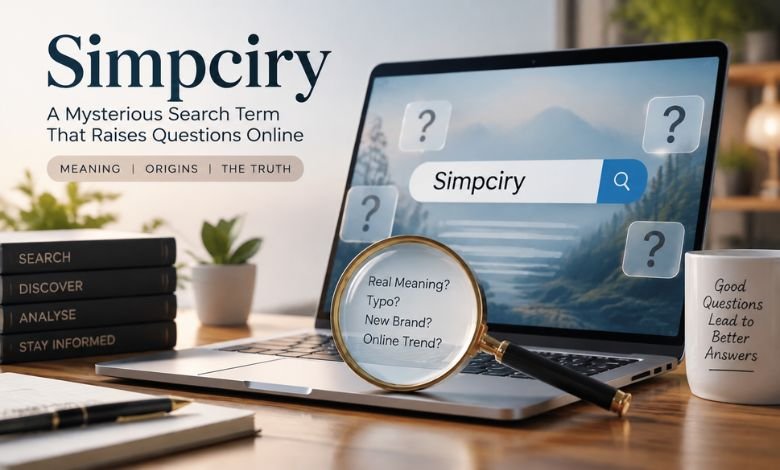
Simpciry is a search term that has no clearly established meaning. It might appear in a search suggestion, in an online comment, in a web address, or in a social media posting, but trustworthy sources do not link the exact spelling to a known company, product, platform, or recognised idea.
Because of that uncertainty there are a number of possible explanations: it might be a typing error, it could be a new name, or it may be a word used in a small online community. Yet none of these possibilities has been proven.
Rather than giving the term a false meaning, it is more useful to look at the places where it occurs, consider the evidence that is available, and see how readers can tell reliable information apart from online speculation.
Why Simpciry Is Difficult to Define
Most well-established terms have a visible history; companies generally have an official website, products have a manufacturer or a listing in a store, and an accepted concept is found in books, dictionaries, studies, or reputable publications.
At the moment this search term lacks that kind of clear background.
There is no definition that is generally accepted for it. In fact, searches do not show a confirmed creator, an official launch date, a headquarters, a service description, or an ownership record that clearly applies to that exact name.
The fact that there is no information means that there are still several possibilities remaining.
The term might be associated with a rather small-scale project which hasn’t received broader recognition; it could alternatively be a username, the name of a private community, an early version of a brand, or a temporary label used on a particular platform.
Another possible explanation is a typing error. When people use a phone keyboard, carry out a voice search, or rely on automatic spelling suggestions, they often type words incorrectly. Just one wrong letter can result in a search query that looks entirely different.
Trouble arises when an assumption is treated as if it were a fact. For example, a writer might look at a word which appears familiar and then decide what it means without referring to the original source. When that explanation is reproduced on other websites, it starts to seem credible.
Just because information is repeated doesn’t mean it’s been verified; sometimes several pages are merely restating the same unsupported interpretation.
How Unknown Words Spread Across the Internet
The internet can cause an ambiguous word to take on a life of its own.
Suppose that a person keys an odd name into a search engine. Another person then sees it in the section of related searches and types it in too. Content publishers observe the increasing interest and start to write articles on the term.
At that stage the search is taking place, but the meaning might still be unknown.
Search engines arrange the information that they find on the web; they don’t automatically verify that each explanation published is correct, a page possibly appearing in the results simply because it includes the correct letters and phrases, even if the claims it makes are weak.
Social media has the effect of accelerating this process; a peculiar word might first show up as a username, a hashtag, a video caption, or in a comment and when it is posted without any context people begin to look for an explanation.
Autocorrect can cause even more confusion since a phone might change one word into another, while voice recognition may generate a wrong spelling according to how the word is pronounced, and the altered version can then be copied into posts, messages, or search boxes.
Curiosity also has a role to play; an unfamiliar term seems like a little online puzzle and people want to know if it’s part of a new app, a secret group, a viral trend, or an emerging service.
The attention leads to more content. Unfortunately, there are cases in which pages attempt to meet the search request even though they don’t have sufficient evidence; in such instances they might make up a background story, list supposed features, or assert that the word denotes a lifestyle movement.
It’s possible for a thorough explanation to be incorrect as well; length, confidence, and professional formatting do not take the place of evidence.
Might Simpciry be a misspelling or a brand name?
Although the spelling is similar to that of other words and online names, merely looking at it is not enough to prove there is a connection.
A possible explanation is that it means “simplicity”. Since the two words have many letters in common, the incorrect term might have been caused by a typing error. Yet no reliable source verifies that this was the word intended.
It might also be confused with “SimpCity”, a name that is used in various online settings. The spellings are similar, but they shouldn’t be considered to be the same name automatically. A difference of just one letter can result in a completely different website, account, or subject.
Another possibility is that the term was intentionally invented as a brand name. It is common for companies to use unusual spellings in order to make their names easier to register or remember. However, the fact that a branding strategy has been employed does not prove that a business actually exists.
A genuine brand should normally have several identifying details, such as:
An official website
A clear description of its products or services
Contact information
Named owners or company representatives
Consistent social media accounts
Privacy and legal information
Independent coverage or customer feedback
Unless these details are available, any statement regarding a brand’s purpose, features, price, or reputation would be purely speculative.
The word can also be used in a private capacity. For example, a group involved in gaming, an online content creator, a student project, or a small community might know what the name means even if it has no public definition.
That is why the original context is important; the place where the word appeared may contain more useful evidence than the word itself.
How to Investigate an Unclear Search Query
The first thing to do is go back to the original source.
When you come across the term in a sentence, you should read the whole paragraph and search for words surrounding it that will indicate the subject; for example, a talk on software provides different clues than does one on fashion, gaming, or personal development.
When the link appears on a website, look at the full address. Fake and deceptive pages often use spellings that are similar to those of reputable brands. Make sure to check all of the domain name before opening it.
Looking for the exact word enclosed in quotation marks will likewise cut down on irrelevant results, after which you can include another piece of information, for example the platform, the username, the industry, or the subject on which you found it.
Useful searches might include:
The exact term with “meaning”
The exact term with “official website”
The exact term with the platform name
The exact term with the surrounding topic
A possible spelling variation
Look up the date on which each result was published since a recent batch of general articles might be evidence that the publishers are reacting to search interest rather than covering a well-established topic.
Check as well the source of each claim. Does the page provide a link to an official statement? Does it name an owner? Can the information be verified independently?
The definition might be based on assumption rather than research if all the articles use the same wording without referring to the original evidence.
Website Verification and Online Safety
One has to take extra care in the case where the term directs one to an unfamiliar website.
Before you set up an account or give out any personal details, make sure you know who is running the website. Check that there is an appropriate About page, contact information, a privacy policy, terms of use, and a clear description of the service offered.
Make sure that the site is using HTTPS since encryption aids in protecting the information sent between your browser and the website; yet the padlock icon does not mean that the operator can be trusted.
Be cautious if the site:
Pressures you to act immediately
Requests unnecessary personal details
Demands payment before explaining the service
Promises unrealistic rewards
Contains several broken pages
Offers unknown files or browser extensions
Uses copied branding or poor contact information
You should not download an application just because its filename includes the search term; instead, you must first check the developer, the source of the file, the device requirements, the permissions, and the developer’s independent reputation.
The National Cyber Security Centre of the UK cautions people against opening suspicious links and also enables individuals to have suspicious websites reported so that they can be investigated.
The fact that there is little information does not mean that the website is dangerous; it only means that there is insufficient evidence to regard it as safe.
Conclusion
Simplicity has drawn attention to itself since it appears to have meaning but is still difficult to identify. There is no current evidence that allows it to be described as a confirmed brand, a service, a website, or a recognised concept.
The original sentence, post, profile, or web address remains the strongest clue. Until that context leads to an official source, every suggested definition should be treated as a possibility rather than a fact.
A mysterious search term may invite a quick explanation, but the honest answer is sometimes that more evidence is needed.
(FAQs)
What Does Simpciry Mean?
There is no definition that has been verified at the present time; it could be a misspelling, a new name, a private term, or a small online project, but none of these explanations have been confirmed.
Is “simplicity” another way of saying that?
It is possible due to the similarity of the spellings, but there is no solid evidence showing that the two words have the same meaning.
Does it have anything to do with SimpCity?
No connection that has been confirmed exists and similarities in spelling should not be taken as evidence that two names refer to the same website or community.
Is it a genuine website?
No officially verified website has so far been identified merely from the term in question. It would be necessary to have the full domain address in order to check the website’s identity, ownership, and purpose.
What Is the Reason That People Are Searching for It?
Interest can arise from social media, search suggestions, a spelling mistake, or references on small websites. While search activity indicates curiosity it does not establish a specific meaning.
How do I work out if a related site is safe?
Look over the entire domain, the details of ownership, the contact information, the privacy policies, any security warnings, and the independent reports. Do not send any personal or payment information until the person in charge has been identified.