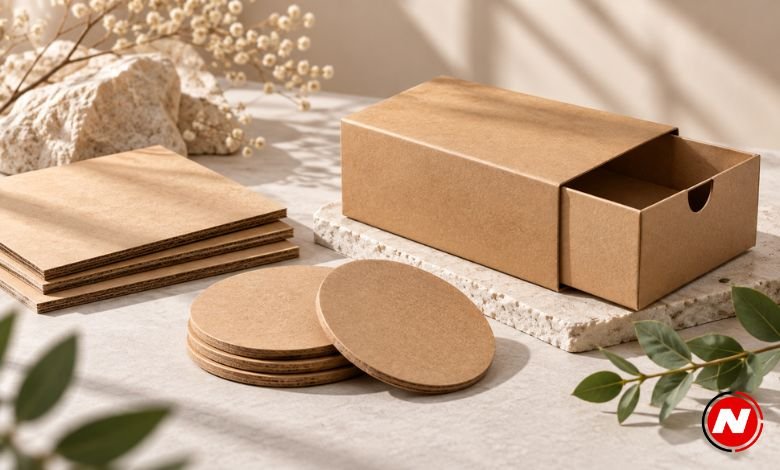
Pappedeckel looks like a simple German word, but translating it into English isn’t as straightforward as it seems. If you search the term online, you may see it described as cardboard, paperboard, a cardboard lid, a cover, or even something placed under a drink.
The confusion comes from language rather than from the object itself. Standard German dictionaries use the closely related forms Pappdeckel and Pappendeckel, and the meaning can shift slightly depending on context.
In most cases, the safest English interpretation is a piece of cardboard or paperboard. In some situations, it may work as a cover, lid, backing piece, or drink coaster. Understanding the surrounding sentence is therefore more useful than relying on a literal translation alone.
What Does Pappedeckel Mean?
The simplest way to understand Pappedeckel is to think of it as cardboard.
The German word Pappe means a firm, fairly stiff material made from layers of paper. Duden describes it as a stiff paper-based material and gives Karton as a related term.
The second part of the word resembles Deckel, which normally means a lid, cover, or removable top. Duden defines Deckel mainly as the part used to close a container and also as a book’s stiff cover.
This makes “cardboard lid” an understandable literal translation. However, it is not always the best translation in normal use.
The standard word Pappdeckel has a wider dictionary meaning. Duden defines it as a piece of cardboard, particularly a rectangular one. Its listed synonyms include Karton and Pappe.
That means someone using the term may not be talking about a lid that closes a box.
They might simply mean a flat piece of cardboard.
This difference is small, but it explains why English-language pages can give several apparently different definitions for the same term.
Pappdeckel, Pappendeckel and Pappedeckel: What Is the Difference?
One of the biggest sources of confusion is spelling.
The established dictionary forms are Pappdeckel and Pappendeckel. Duden lists both as masculine German nouns and describes them with essentially the same basic meaning: a piece of cardboard. Each dictionary entry also identifies the other as a related form.
The form Pappedeckel is the spelling that many English-speaking searchers now encounter online. When researching its meaning, however, it helps to compare it with recognized German forms rather than assume every online explanation reflects standard German usage.
This matters especially because German compound words can look more literal in English than they are in everyday speech.
Take Pappdeckel. Someone unfamiliar with German may split it into “cardboard” and “lid” and stop there.
A German dictionary gives a broader result: a piece of cardboard.
This is a useful reminder that translating compound words word by word does not always produce the most natural meaning.
The surrounding situation matters too. If the object is covering a container, “cardboard lid” may be perfectly suitable. If it is a flat sheet used underneath another object, “piece of cardboard” makes more sense.
For translators, students and curious readers, context should decide the final English wording.
Why Is the Word Linked With Drink Coasters?
The connection between the word and drinks is not simply an internet invention.
Duden gives an example for Pappdeckel involving a drink being served on one. That shows how a flat piece of cardboard can go under a glass or other drink container.
In English, an object used this way is often called a drink coaster or cardboard coaster.
That does not mean every Pappdeckel is a coaster.
It simply shows how a general piece of cardboard can take on a more specific purpose.
Imagine a café or traditional bar. A small, flat disc or square of absorbent board sits beneath a glass. Its job is simple: catch moisture, protect the table and provide a clean surface underneath the drink.
In that setting, calling the object a coaster is much more natural than calling it a “cardboard lid.”
In another setting, perhaps a workshop, classroom or packaging area, the same general cardboard-related word could describe something completely different.
That is why Pappedeckel shouldn’t be tied permanently to one object.
Its practical meaning comes from how the cardboard piece is being used.
Cardboard, Paperboard and Everyday Uses
Cardboard is so common that people rarely stop to think about the many roles it plays.
A small sheet can become backing for a photograph. A thicker piece may protect an item inside a parcel. A cut section can serve as a divider, craft material, temporary cover, label support or coaster.
That flexibility helps explain why translating cardboard-related German vocabulary can be difficult.
English itself uses several overlapping terms, including:
cardboard, paperboard, card, board, cardboard sheet, cardboard cover and coaster.
They are related, but they do not always describe the same thing.
The German word Pappe is similarly broad. Duden describes it as a stiff material produced from layers of paper and lists Karton among its synonyms.
Because of that, the best translation should describe the actual item in front of you.
If it is flat material, “piece of cardboard” may be best.
If it forms the top of packaging, “cardboard lid” or “cardboard cover” may sound more natural.
If it sits under a beer glass or cup, “cardboard coaster” may be the clearest choice.
The lesson is simple: translate the function, not just the spelling.
Why Pappedeckel Is Attracting Online Searches
Unusual foreign words often attract attention because they seem simple but can mean several different things.
Pappedeckel is a good example.
A reader may encounter it on a website, in a product description, in a German sentence or through a search result. They then find one page calling it cardboard and another calling it a lid.
At first, these explanations appear to conflict.
In reality, they may be describing different uses of the same basic cardboard-related idea.
Another source of confusion is that the standard dictionary spelling may not be the spelling a person originally searched for. Checking Pappdeckel and Pappendeckel provides a firmer linguistic reference point.
For anyone researching German vocabulary, this is a useful habit.
Look beyond literal translation. Check standard spellings. Then examine the sentence, object and setting in which the word appears.
Doing those three things usually gives a much clearer answer than relying on a single automatic translation.
Conclusion
Pappedeckel may appear mysterious at first, but the idea behind it is quite ordinary. It relates to cardboard or paperboard and is best understood alongside the established German words Pappdeckel and Pappendeckel.
The key point is that you don’t need to force one English translation into every situation. A Pappdeckel may simply be a piece of cardboard. In another setting, that piece may function as a cover, lid or drink coaster.
That small difference shows why context matters so much in language.
Sometimes the most accurate translation is not the most literal one. With Pappedeckel, looking at how the object is actually being used gives you the clearest answer.
(FAQs)
What does Pappedeckel mean in English?
It generally refers to cardboard, paperboard or a piece of cardboard. Depending on the situation, an English translation could also be cardboard cover, cardboard lid or cardboard coaster.
Is Pappedeckel a standard German spelling?
The standard dictionary forms documented by Duden are Pappdeckel and Pappendeckel. Both are defined as a piece of cardboard.
Does Pappdeckel literally mean cardboard lid?
The parts of the word can suggest that meaning because Pappe relates to cardboard and Deckel means lid or cover. However, the dictionary meaning of Pappdeckel is broader and refers to a piece of cardboard.
Can Pappedeckel mean a drink coaster?
In the right context, yes. Duden gives an example in which a drink is served on a Pappdeckel, so “cardboard coaster” can be a natural English translation when the object is being used beneath a drink.
What is the difference between Pappdeckel and Pappendeckel?
There is little difference in their basic dictionary meaning. Duden treats them as related forms and defines both as a piece of cardboard.
Is Pappedeckel a special type of packaging?
Not necessarily. The term is connected with cardboard and objects made from it, but it should not automatically be treated as the name of one special packaging product. The exact object depends on context.