Picture a plumber with a full diary and an empty bookkeeping folder. The receipts live in a van door pocket. Four hundred bank transactions sit uncoded, and the VAT deadline lands in three weeks. Sound familiar? Most owners reach this point eventually, because customers always win against paperwork. Outsourced bookkeeping services can rebuild the records and set up a routine that holds. Here’s where to start, what to gather and how to stop it happening twice.
What does catch-up bookkeeping actually means?
It’s repair work. Routine bookkeeping logs transactions as they happen, and annual accounts wrap up the year. Catch-up bookkeeping fills the hole between them.
Sole traders need it. So do limited companies, new businesses and anyone switching accountants mid-mess. How much work you’re facing depends on four things: how long the books have been ignored, how many transactions there are, what paperwork has vanished, and how complicated the business is. And it isn’t just data entry. Someone has to check every entry against the bank.
Four signs you’re behind
You probably know already. Bank transactions that don’t match anything. Receipts you can’t find. No clue what profit you’ve made, or what tax you’ll owe. A deadline that’s closer than your figures are ready.
One or two of those are untidy. All four are in the backlog.
Where to start?
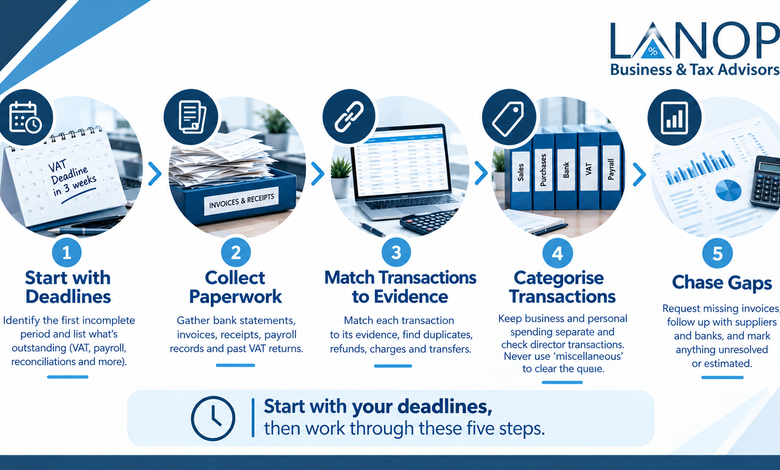
Start with the deadlines, not the oldest transaction. Find the first month that’s incomplete, then list what’s outstanding: reconciliations, VAT returns, payroll, and any letters from HMRC. Anything urgent goes first, even if the history behind it is still a mess.
Next, collect your paperwork. Bank and card statements come first, then sales and purchase invoices, receipts, payment processor reports, payroll records and old VAT returns. If a previous accountant held your files, ask for access now. Waiting only makes it slower.
Then reconcile. Match each bank and card transaction to its evidence, and hunt for duplicates, refunds, bank charges and transfers between your own accounts. Don’t trust a bank feed to do this for you. It imports what the bank saw, not what’s correct.
Categorising comes next, and it’s where people cut corners. Keep business and personal spending apart. Check drawings and director transactions. When an entry is unclear, find out what it was instead of dumping it in “miscellaneous” to empty the queue.
Finally, chase the gaps. Ask suppliers for replacement invoices and your bank for duplicate statements. Mark anything unresolved, and label every estimate as an estimate. Before you rely on any report, confirm which periods are finished and which questions remain open.
What if the paperwork is gone?
You can still work with it. Suppliers can usually send copies, and bank statements, emails and payment records can support a transaction. What you can’t do is invent a figure, or treat every mystery payment as a business expense. Some items need real investigation before the accounts can be finalised, and that’s normal.
What will it cost?
It depends, and any provider who quotes before seeing your records is guessing. The main drivers are months outstanding, transaction volume, number of bank accounts and the state of your documents. VAT, payroll and tight deadlines add more.
Expect two separate costs: a one-off clean-up, then ongoing monthly bookkeeping. Ask for the scope in writing. It should name the periods, accounts and reconciliations included.
DIY or professional help?
If the backlog is small, your records are tidy and your transactions are simple, do it yourself. Accounting software plus a steady habit will get you there.
Everything else points to help: a big backlog, missing documents, VAT worries, the same reconciliation errors coming back, or no spare evenings. Hours spent untangling last year are hours you’re not earning. That’s the case for outsourced bookkeeping services. You clear the backlog and set up a working process without hiring someone full time. Compare fees, responsibilities, data security and how the provider checks its own work.
Don’t confuse the roles. A bookkeeper keeps transaction records and reconciliations. An accountant prepares accounts and advises on tax. Plenty of firms do both, so the agreed scope matters more than the job title.
Missed a deadline?
If a return hasn’t gone in, find the date, gather what you can and get advice quickly if you can’t produce an accurate figure.
If you’ve filed wrong VAT figures, the fix depends on the size of the error. A careless error of £10,000 or less usually goes on your next return. Errors above that, up to 1% of your Box 6 figure with a £50,000 cap, can often follow the same route. Anything bigger, or anything deliberate, goes to HMRC directly. Check HMRC’s current guidance before acting.
And no, a backlog doesn’t automatically bring an investigation. It does make your figures harder to defend when someone asks questions.
Choosing a provider
Inquire about what components the quote encompasses: data entries, reconciliations, requests regarding missing data, VAT work. Also, ascertain what procedure is in place to deal with errors and gaps, and whether clean-up is billed separately from monthly fees. Find out how the documents will be transferred and who has access to your accounts. Changing the provider? Get access to the software, reconciliations from the previous provider, past submissions and a list of the issues they are dealing with.
Keeping it from happening again
Little sometimes triumphs over big and uncommon. In order to upload the receipts, check out the transactions and hunt down unpaid invoices, it takes only fifteen minutes a week. Monthly reconciliation should be performed and anything suspicious looked at closely. Get the bank feed and the document upload to do the typing, and review what is produced as a result. One person should be responsible for the task. Otherwise accountability may be nobody’s business.
Frequently asked questions
Can I catch up on six months of bookkeeping?
In most cases, yes. The transaction volume, record quality, and complexity of the business will determine the volume of work.
How long does it take to catch up on bookkeeping?
Unfortunately, there is no standard answer. The time taken will depend on several factors such as the number of months for which the accounts are outstanding, the number of missing documents, and the number of accounts.
What should I do if I have lost my business receipts?
You can reach out to suppliers for duplicate receipts or you can use bank statements or email correspondence as a proof. The tax treatment would depend upon the scenario.
Can I change my bookkeeper while my records are lagging?
The answer is yes. You should request access to the software of your previous provider along with reconciliations, prior submission records, and a list of pending issues.
How frequently should I carry out my reconciliations?
For most of the small businesses, a monthly reconciliation is a wise practice.
Conclusion
Delayed tasks look worse than they really are. It is necessary to establish deadlines, collect documents, cross-reference accounts and close the gaps. After this, one must start a habit to avoid repeating the task. Prior to calling anyone, determine the unpaid periods and existing documents. This is enough to save a lot of time.
If you are willing to let the professionals do the job, Lanop Business & Tax Advisors provides outsourced bookkeeping services to UK companies including correcting records that are delayed for numerous months or even years. You need to inform us about the delayed periods and deadlines. Learn more from the bookkeeping service page.