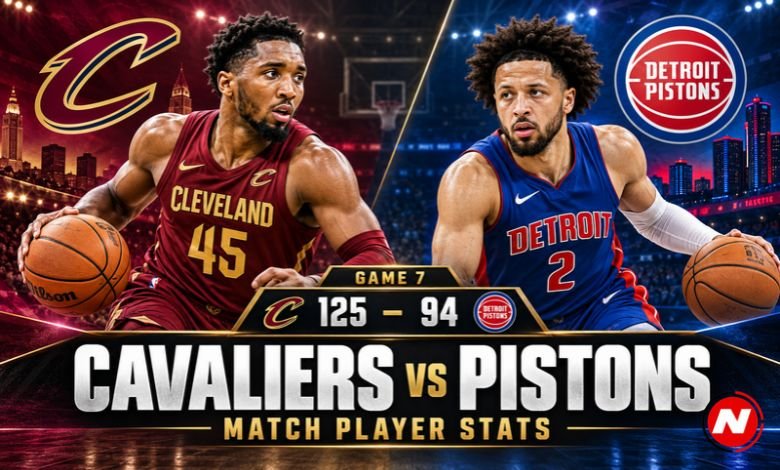
A place in the conference finals was on the line, but Cleveland turned the deciding game into a one-sided finish. The Cleveland Cavaliers vs Detroit Pistons match player stats reveal how the Cavaliers secured a 125–94 victory at Little Caesars Arena on 17 May 2026, winning their Eastern Conference semi-final series 4–3.
Donovan Mitchell led the scoring with 26 points, yet Cleveland’s success reached well beyond its leading guard. Jarrett Allen and Sam Merrill each scored 23, while Evan Mobley delivered 21 points and 12 rebounds.
Detroit needed a response strong enough to match that collective output. Instead, missed shots and limited scoring from several starters left the home side chasing a growing deficit.
Game 7 overview: Cleveland increased the pressure every quarter
The final margin suggests a sudden collapse, but the quarter-by-quarter scores show something more consistent. Cleveland won all four periods, gradually removing Detroit’s chances of building a comeback.
| Quarter | Cleveland Cavaliers | Detroit Pistons |
|---|---|---|
| First | 31 | 22 |
| Second | 33 | 25 |
| Third | 35 | 26 |
| Fourth | 26 | 21 |
| Final | 125 | 94 |
A nine-point advantage after the opening quarter became a 64–47 lead at half-time. Cleveland then scored another 35 points in the third, entering the final period ahead 99–73.
Mitchell supplied 15 points in that third quarter. His burst helped turn a difficult situation for Detroit into a much larger challenge, with the Cavaliers continuing to find answers after the interval.
The Cleveland Cavaliers vs Detroit Pistons match player stats therefore describe sustained control. Detroit could not win a quarter, reduce the half-time gap or create a late contest.
The result sent Cleveland into its first Eastern Conference finals since 2018. For Detroit, the defeat ended a series that had still been level before tip-off.
Cleveland Cavaliers player stats: Four different scoring threats
Cleveland’s main scorers offered different problems for Detroit. Mitchell provided the highest individual total, Allen produced inside, Merrill punished from long range and Mobley contributed across several categories.
The following Cavaliers box score covers the leading scorers and other key rotation players.
| Player | Points | Rebounds | Assists | Field goals | Three-pointers |
|---|---|---|---|---|---|
| Donovan Mitchell | 26 | 6 | 8 | 10/22 | 2/6 |
| Jarrett Allen | 23 | 7 | 1 | 8/14 | 0/0 |
| Sam Merrill | 23 | 1 | 2 | 7/10 | 5/8 |
| Evan Mobley | 21 | 12 | 6 | 7/10 | 1/4 |
| James Harden | 9 | 5 | 6 | 2/10 | 0/6 |
| Max Strus | 9 | 3 | 2 | 3/7 | 1/5 |
| Dean Wade | 5 | 6 | 1 | 2/2 | 1/1 |
| Dennis Schröder | 2 | 3 | 3 | 1/1 | 0/0 |
Field goals and three-pointers are shown as baskets made/attempted.
Mitchell’s eight assists matter alongside his scoring. He finished without an individual turnover, giving Cleveland a productive combination of shot creation, passing and ball security.
Merrill delivered exceptional shooting efficiency. His five three-pointers from eight attempts produced 15 of his 23 points, and he also made all four free throws. That scoring from the bench gave Cleveland another player Detroit had to track closely.
Allen reached 23 points without attempting a three-pointer. His eight field goals and seven successful free throws show how much his scoring came through interior opportunities and trips to the line.
Mobley’s double-double was the broadest contribution of the four. Alongside 21 points and 12 rebounds, he supplied six assists, two steals and two blocks. His involvement extended from finishing possessions to helping create and stop them.
Harden’s shooting was much less effective, but Cleveland could absorb it. The four leading scorers combined for 93 points, leaving the team less dependent on every starter having a strong shooting night.
Detroit Pistons player stats: Jenkins led a struggling attack
Detroit’s scoring distribution told a different story. Daniss Jenkins finished with 17 points, while Cade Cunningham and Duncan Robinson each added 13.
Those contributions were not enough against a Cleveland side with four players above 20 points. The Pistons box score also shows how little scoring came from several other starters.
| Player | Points | Rebounds | Assists | Field goals | Three-pointers |
|---|---|---|---|---|---|
| Daniss Jenkins | 17 | 3 | 5 | 4/12 | 2/7 |
| Cade Cunningham | 13 | 4 | 5 | 5/16 | 0/7 |
| Duncan Robinson | 13 | 1 | 1 | 4/7 | 3/5 |
| Caris LeVert | 11 | 2 | 2 | 3/5 | 2/4 |
| Marcus Sasser | 9 | 2 | 1 | 3/12 | 3/9 |
| Jalen Duren | 7 | 9 | 3 | 3/7 | 0/0 |
| Ausar Thompson | 5 | 7 | 0 | 2/7 | 1/2 |
| Tobias Harris | 5 | 5 | 2 | 0/6 | 0/2 |
Jenkins drew value from the free-throw line, making seven of eight attempts. However, his four baskets from 12 shots meant Detroit’s leading scorer was also working through an uneven shooting performance.
Cunningham’s three-point shooting was a major difficulty. He missed all seven attempts from beyond the arc and finished with five successful field goals from 16 shots overall.
Robinson and LeVert were more accurate, combining for five three-pointers from nine attempts. Their contributions offered some support, but could not cover the wider shortage of baskets.
Harris, Thompson and Duren combined for 17 points. Duren led Detroit with nine rebounds, yet the starting frontcourt’s limited scoring made the task harder for the guards.
These figures show why one improved individual performance would probably have been insufficient. Detroit needed a broader attacking response to close such a large gap.
Team statistics: The decisive gap was inside the arc
The Cleveland Cavaliers vs Detroit Pistons match player stats become clearer when placed beside the team totals. Both sides attempted 85 field goals, but Cleveland made 13 more baskets.
| Statistic | Cavaliers | Pistons |
|---|---|---|
| Field goals | 43/85 | 30/85 |
| Field-goal percentage | 50.6% | 35.3% |
| Three-pointers | 11/34 | 12/39 |
| Free throws | 28/44 | 22/29 |
| Player rebounds | 50 | 41 |
| Assists | 31 | 21 |
| Points in the paint | 58 | 34 |
Detroit actually made one more three-pointer. Cleveland’s advantage therefore cannot be explained simply by long-range shooting.
Subtracting three-pointers from total field goals gives Cleveland 32 two-point baskets and Detroit 18. That calculation highlights the size of the difference closer to the basket.
The paint scoring supports the same reading. Cleveland’s 58–34 advantage there was far more substantial than the difference in three-point production.
Rebounding and passing added to the separation. The Cavaliers collected nine more player rebounds and recorded ten more assists, supporting the picture of a side creating and completing more productive possessions.
Cleveland still left points behind at the free-throw line, missing 16 attempts. Even with that weakness, its stronger overall shooting and interior scoring provided enough room for a comfortable victory.
Conclusion
The Cleveland Cavaliers vs Detroit Pistons match player stats show how a deciding game became a convincing team victory. Mitchell led the scoring, while Allen, Merrill and Mobley ensured Cleveland had several reliable sources of points.
Detroit found useful contributions from Jenkins, Robinson and LeVert, but its wider shooting struggles prevented a recovery. Cleveland kept adding to its advantage, turning four winning quarters into a place in the conference finals.
(FAQs)
Who won Game 7 between Cleveland and Detroit?
Cleveland won 125–94 on 17 May 2026 at Little Caesars Arena, securing the Eastern Conference semi-final series 4–3.
Who led the Cleveland Cavaliers vs Detroit Pistons match player stats in scoring?
Donovan Mitchell led all scorers with 26 points. Jarrett Allen and Sam Merrill followed with 23 each.
How many points and rebounds did Evan Mobley record?
Mobley finished with 21 points and 12 rebounds. He also contributed six assists, two steals and two blocks.
Who was Detroit’s leading scorer?
Daniss Jenkins led the Pistons with 17 points. Cade Cunningham and Duncan Robinson each scored 13.
How many three-pointers did Sam Merrill make?
Merrill made five three-pointers from eight attempts, shooting 62.5% from beyond the arc.
What was the biggest statistical difference between the teams?
Overall shooting and interior scoring stood out. Cleveland shot 50.6% against Detroit’s 35.3% and outscored the Pistons 58–34 in the paint.