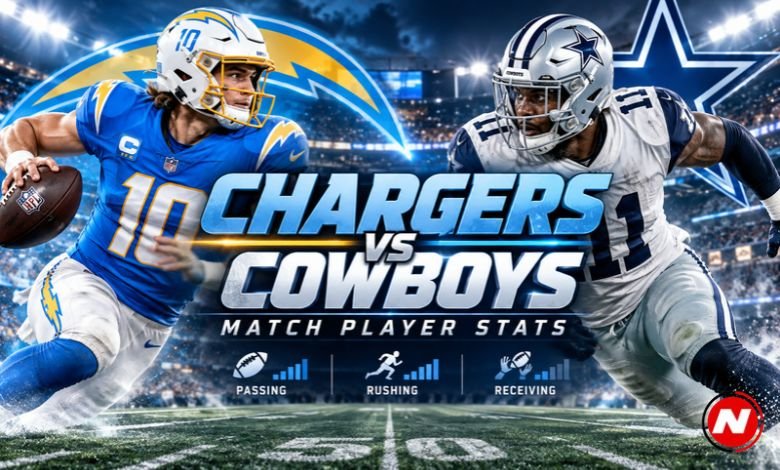
Football matches are often remembered for the final score, but the real story usually lies in the moments leading up to it. The Chargers vs Dallas Cowboys match player stats show how a competitive afternoon turned into a comfortable win for Los Angeles.
The two teams met on 21 December 2025 at AT&T Stadium in Arlington, Texas. Dallas made an encouraging start, with Dak Prescott moving the ball confidently and George Pickens causing problems for the visiting defence. However, the Chargers had Justin Herbert in excellent form, and they gradually took control.
Los Angeles eventually won 34–17, scoring 13 points without reply after half-time. Herbert’s passing, Omarion Hampton’s running and several important defensive stops helped secure the result.
Here is a closer look at the players, statistics and moments that made the difference.
Chargers vs Dallas Cowboys Match: How the Game Unfolded
The Cowboys could hardly have asked for a better opening drive. Prescott looked comfortable from the first snap, finding space in the Chargers’ defence and moving his team down the field.
The drive ended with a five-yard touchdown pass to Ryan Flournoy, giving Dallas an early 7–0 lead.
Los Angeles did not allow that advantage to last long. Herbert responded with a well-organised drive of his own, finishing with a 23-yard touchdown pass to Quentin Johnston.
The first quarter ended with the scores level, but the second brought more drama.
Brandon Aubrey kicked a 33-yard field goal to put Dallas ahead again. Herbert then found Ladd McConkey for a 25-yard touchdown, turning the score in the Chargers’ favour.
George Pickens answered with a brilliant 38-yard touchdown reception from Prescott. Dallas were back in front at 17–14, and the home crowd had plenty to celebrate.
Then came a drive that changed the feel of the match.
The Chargers used 16 plays to travel 81 yards, keeping possession for almost eight minutes. Herbert finished the drive with a one-yard rushing touchdown, putting Los Angeles ahead 21–17 just before half-time.
Dallas remained within touching distance, but the second half belonged to the visitors.
Cameron Dicker kicked two field goals, and Hampton added a late rushing touchdown. The Cowboys failed to score another point.
Final Score by Quarter
| Team | Q1 | Q2 | Q3 | Q4 | Total |
|---|---|---|---|---|---|
| Los Angeles Chargers | 7 | 14 | 3 | 10 | 34 |
| Dallas Cowboys | 7 | 10 | 0 | 0 | 17 |
The Chargers vs Dallas Cowboys match player stats reflect this change clearly. Dallas were competitive early on, but Los Angeles played better when the match became more demanding.
Justin Herbert and Dak Prescott: Passing Stats Compared
Both starting quarterbacks produced some excellent football, particularly before the interval.
Herbert was more productive overall, but Prescott also had moments that showed his experience and ability.
Justin Herbert Enjoys a Strong Afternoon
Herbert completed 23 of his 29 passes for 300 yards and two touchdowns. He did not throw an interception, finishing with a completion rate of 79.3%.
Those numbers tell us plenty about his accuracy, although they do not fully explain how much trouble he caused Dallas.
Whenever the Cowboys tried to increase the pressure, Herbert seemed capable of finding an answer. Sometimes he released the ball quickly. On other occasions, he escaped the pocket and created something with his legs.
His 34-yard run in the fourth quarter was a perfect example.
With Dallas attempting to put pressure on him, Herbert spotted an opening and ran straight through the middle of the field. The play helped the Chargers move into scoring position.
He finished with 42 rushing yards and a rushing touchdown alongside his passing numbers.
Dallas did not record a sack against him, which made life considerably easier for the Chargers’ attack.
Dak Prescott Gives Dallas a Chance
Prescott had a productive first half and finished with respectable figures despite the defeat.
He completed 21 of 30 passes for 244 yards and two touchdowns, without throwing an interception.
His 70% completion rate showed that passing accuracy was not Dallas’ main problem.
Prescott connected particularly well with Pickens, whose speed and ability to make difficult catches gave the Chargers plenty to think about.
He also found Flournoy for the opening touchdown.
However, things became harder after half-time. The Cowboys struggled to finish drives, and the Chargers’ defence became increasingly difficult to break down.
Quarterback Stats
| Player | Passes | Yards | TDs | INT |
|---|---|---|---|---|
| Justin Herbert | 23/29 | 300 | 2 | 0 |
| Dak Prescott | 21/30 | 244 | 2 | 0 |
| Joe Milton | 2/2 | 11 | 0 | 0 |
Herbert finished with more passing yards, a higher completion percentage and an additional rushing score.
That extra dimension made him the most influential quarterback on the field.
Rushing and Receiving Stats: The Players Behind the Big Plays
Quarterbacks may lead the attack, but they need support from the players around them.
The Chargers vs Dallas Cowboys match player stats reveal an interesting contrast. Los Angeles shared the workload across several players, while Dallas depended heavily on a few standout performances.
Omarion Hampton Makes His Presence Felt
Omarion Hampton gave the Chargers a reliable running option throughout the afternoon.
He carried the ball 16 times for 85 yards, averaging 5.3 yards per attempt.
His biggest contribution came late in the fourth quarter, when he ran five yards for a touchdown.
By then, Los Angeles had already established control, but Hampton’s score effectively ended any hope of a Dallas comeback.
Herbert’s 42 rushing yards provided further support. Hassan Haskins added 14 yards, and Kimani Vidal contributed 11.
The Chargers finished with 152 rushing yards as a team.
That balance mattered because Dallas had to defend against both the pass and the run.
Dallas Finds Limited Success on the Ground
The Cowboys did not enjoy the same success with their running game.
Javonte Williams finished with 34 rushing yards from nine carries, while Malik Davis added 23 yards on eight attempts.
Dallas managed just 91 rushing yards overall.
Neither Williams nor Davis scored a touchdown, leaving most of the attacking responsibility with Prescott and his receivers.
It was not simply a question of individual ability. The Cowboys struggled to create enough consistent running opportunities to keep the Chargers guessing.
George Pickens Leads the Receivers
One Dallas player who certainly made his mark was George Pickens.
He caught seven passes for 130 yards and a touchdown, leading all players in receiving yards.
His 38-yard scoring catch was one of the best moments of the game.
CeeDee Lamb also played his part, finishing with six receptions for 51 yards. During the match, Lamb passed 1,000 receiving yards for the fifth consecutive season.
For the Chargers, Quentin Johnston led the way with 104 yards from four catches.
Tre Harris added 54 yards, while Keenan Allen contributed 44. Ladd McConkey recorded 43 receiving yards, including an important touchdown.
Leading Receivers
| Player | Team | Catches | Yards | TD |
|---|---|---|---|---|
| George Pickens | Cowboys | 7 | 130 | 1 |
| Quentin Johnston | Chargers | 4 | 104 | 1 |
| Tre Harris | Chargers | 4 | 54 | 0 |
| CeeDee Lamb | Cowboys | 6 | 51 | 0 |
| Keenan Allen | Chargers | 5 | 44 | 0 |
| Ladd McConkey | Chargers | 4 | 43 | 1 |
Pickens had the best individual receiving figures, but Los Angeles benefited from having several dependable targets.
That made its passing attack more difficult for Dallas to contain.
Defensive Stats and the Plays That Changed Everything
There was no shortage of attacking football in the first half. Both sides moved the ball well, and the lead changed hands several times.
The second half was a different story.
Dallas failed to score, despite having opportunities to make the game close again.
One of the most important moments came in the third quarter.
The Cowboys had moved the ball to the Chargers’ 16-yard line and faced fourth-and-one. Instead of kicking a field goal, they attempted to gain the first down.
Hunter Luepke was stopped for no gain.
It was a major defensive success for Los Angeles. Dallas had a chance to reduce the deficit but came away empty-handed.
The Chargers also made life difficult for the Cowboys in other key situations.
Although Dallas gained 340 total yards, much of that production came before the visitors tightened their defence.
The Cowboys’ own defence could not put enough pressure on Herbert. Despite facing a Chargers offensive line that had struggled with sacks earlier in the season, Dallas failed to bring him down behind the line.
Late in the contest, Derwin James Jr. forced a fumble from backup quarterback Joe Milton, which Los Angeles recovered.
Important Team Statistics
| Statistics | Chargers | Cowboys |
|---|---|---|
| Total Yards | 452 | 340 |
| Rushing Yards | 152 | 91 |
| First Downs | 24 | 18 |
| Third-Down Conversions | 7/11 | 4/9 |
| Turnovers Lost | 0 | 1 |
| Time of Possession | 34:27 | 25:33 |
The Chargers held the ball for almost nine minutes longer than Dallas.
They also gained more yards and converted third downs more effectively.
Those advantages helped Los Angeles control the pace of the game, especially during the final two quarters.
What the Stats Reveal About the Chargers’ Victory
A 17-point winning margin might suggest that the Chargers dominated from beginning to end. That was not the case.
Dallas played well enough in the opening half to make the contest interesting. Prescott was finding receivers, Pickens looked dangerous and the Cowboys briefly led in the second quarter.
The difference was what happened afterwards.
Los Angeles stayed patient. Herbert continued to make good decisions, the running game remained useful and the defence produced important stops.
The Chargers were also far more effective at keeping drives alive.
They converted seven of their 11 third-down attempts, giving themselves more opportunities to score and keeping the Dallas attack off the field.
For the Cowboys, there were individual performances worth recognising, but the overall team display lacked consistency.
The result moved Los Angeles to an 11–4 record and strengthened its position in the AFC playoff picture.
Dallas dropped to 6–8–1, having already been eliminated from postseason contention.
The Chargers vs Dallas Cowboys match player stats underline a familiar lesson in American football: having talented players is important, but performing well at the right moments is what wins matches.
Conclusion
The Chargers vs Dallas Cowboys match player stats provide a clear picture of an entertaining game that changed after half-time.
Justin Herbert was the driving force behind the Chargers’ attack, combining accurate passing with useful rushing contributions. Omarion Hampton gave Los Angeles balance, while Quentin Johnston and Ladd McConkey made important plays in the passing game.
Dallas had its own bright moments. George Pickens delivered an excellent receiving performance, and Dak Prescott played well for much of the afternoon.
But Los Angeles were the stronger team when the result was still there to be decided.
The Chargers protected their lead, controlled possession and made fewer mistakes. By the final whistle, their 34–17 victory felt fully deserved.
(FAQs)
Who won the Chargers vs Dallas Cowboys game?
The Los Angeles Chargers won 34–17 against the Dallas Cowboys on 21 December 2025 at AT&T Stadium in Arlington, Texas.
How many passing yards did Justin Herbert record?
Justin Herbert threw for 300 yards, completing 23 of 29 passes. He also recorded two passing touchdowns and one rushing touchdown.
Which player had the most receiving yards?
George Pickens led the match with 130 receiving yards from seven catches. He also scored one touchdown for Dallas.
Who was the leading running back?
Omarion Hampton was the leading rusher, gaining 85 yards on 16 carries and scoring a fourth-quarter touchdown for the Chargers.
Why couldn’t the Cowboys score in the second half?
Dallas struggled to finish its attacking drives, while the Chargers’ defence made several important stops. A failed fourth-down attempt in the third quarter was particularly costly.