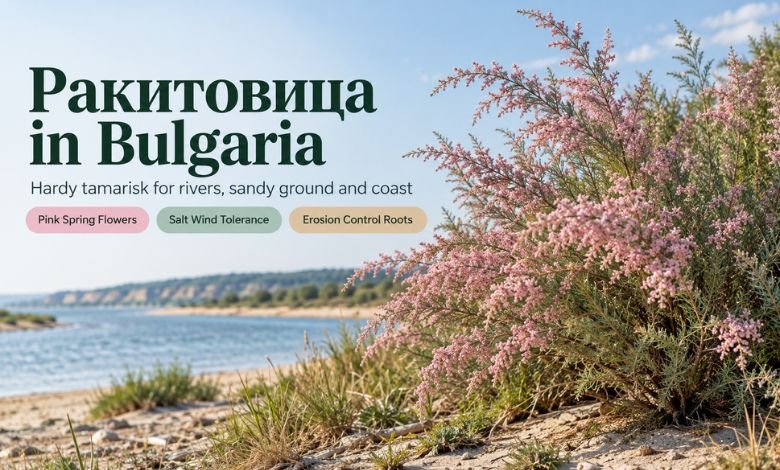
Few plants handle difficult ground as calmly as ракитовица. Known internationally as tamarisk and botanically linked to the Tamarix genus, it grows in places where heat, wind, salt and poor soil can defeat less adaptable shrubs. Its fine branches, tiny scale-like leaves and soft pink flowers give it a light appearance, yet the plant is supported by a strong root system and unusual survival skills.
In Bulgaria, ракитовица is found mainly near rivers, sandy ground and the Black Sea coast. It is valued as a decorative shrub, a source of nectar and a natural aid in soil protection. Two species are recognised as naturally occurring in Bulgaria: four-stamen tamarisk, Tamarix tetrandra, and branched tamarisk, Tamarix ramosissima. Both show how a modest-looking plant can play an important role in fragile landscapes.
What Is Ракитовица?
Ракитовица is the Bulgarian name commonly used for tamarisk plants in the Tamarix group. These plants belong to the Tamaricaceae family, which includes shrubs, small trees and, in some cases, low-growing forms. Depending on the species and growing conditions, tamarisks can reach several metres in height.
Their appearance is easy to recognise. The branches are narrow and often arch away from the main stems, creating an open crown. The leaves are extremely small and scale-like, sitting close to the twigs rather than spreading like the leaves of broad-leaved trees. This reduced leaf surface helps the plant limit water loss in hot and dry weather.
The flowers are small but produced in large numbers. They are usually pink, pale purple or whitish and grow in slender clusters along the younger branches. In Bulgaria, branched tamarisk can flower from May into August, with fruit developing later in the season.
The plant’s delicate outline can be misleading. Under the soil, its roots search widely for moisture and help anchor loose ground. Some tamarisk species also have salt-secreting glands on their leaves. These glands allow excess salt to reach the leaf surface, where it can be washed away or fall to the ground.
Where Does Ракитовица Grow in Bulgaria?
The natural range of ракитовица in Bulgaria is closely connected with water and exposed terrain. It grows beside rivers, on gravel banks, in sandy areas and along sections of the Black Sea coastline. These habitats can change quickly because of flooding, drought, shifting sediment and salty winds.
Tamarix ramosissima has been recorded in a number of Bulgarian floral regions, including the Black Sea coast, the Danube Plain, the Struma Valley, the Thracian Lowland and the Eastern Rhodopes. This wide distribution reflects its ability to cope with different soils and local climates.
The plant is not restricted to wet ground. It may stand close to water but still experience long dry periods, particularly on sandy riverbanks and coastal sites. Its roots help it survive these changes, while its narrow foliage reduces the amount of moisture lost through transpiration.
Coastal ракитовица also faces salt carried by sea spray and salt found naturally in the soil. Many garden shrubs struggle in such conditions, but tamarisk has evolved to tolerate them. This makes it useful in places where planting choices are limited.
The Main Species Found in Bulgaria
The two native species are similar, but they are not identical.
Four-Stamen Tamarisk
Four-stamen tamarisk, known as Tamarix tetrandra, is generally a deciduous shrub or small tree. It often grows to between 1.5 and 2 metres, although it can reach about 4 metres in favourable conditions. Its branches may form graceful arches, and its blue-green scale-like leaves give the plant a soft texture.
The flowers are usually pale pink and appear in clusters during spring. The species takes its common name from the structure of its flowers, which contain four stamens. It can respond well to pruning, so it is sometimes used as a flowering shrub or informal hedge in parks and gardens.
Branched Tamarisk
Branched tamarisk, Tamarix ramosissima, is a taller shrub that may grow to about 3 or 4 metres. Young twigs are green, while older stems become brown. Its tiny leaves are closely attached to the branches, creating a fine, almost feathery effect when viewed from a distance.
The flowers are pink or violet and may continue through much of the summer. After flowering, the plant develops small capsules containing light seeds with tufted hairs. These hairs help the seeds move with the wind, allowing new plants to colonise open ground.
Why Ракитовица Matters to the Environment
The value of ракитовица goes beyond its appearance. One of its most important roles is soil stabilisation. Riverbanks, dunes and sandy coastal areas can be easily damaged by water movement and strong winds. Tamarisk roots bind loose particles and help reduce the speed at which soil is washed or blown away.
For this reason, tamarisk is used to strengthen sandy terrain and exposed ground. It can act as a pioneer plant, establishing itself before other species are able to grow. Once the soil becomes more stable, additional vegetation may gain a better chance of taking root.
Its flowers also support insects. Bees and other pollinators visit the flower clusters for nectar, especially in places where the range of flowering plants becomes smaller during hot or dry periods. A group of tamarisks can therefore provide a useful seasonal food source.
The shrub also creates shelter for small organisms. Its branches offer cover for insects and other small wildlife, while its roots contribute to the structure of soil near watercourses. These benefits are modest when viewed separately, but they become more important where natural vegetation has been disturbed.
There is, however, a practical point to consider. Tamarisk is efficient at surviving dry conditions, but large plants can use substantial amounts of water when moisture is available. In garden design, it should be placed where its growth will not compete heavily with crops or young trees for limited water.
Growing Ракитовица in a Garden
Ракитовица can be a useful choice for gardeners who need a hardy shrub for a sunny, exposed position. It performs best in full sun and can tolerate sandy, stony or moderately poor soil. Good drainage is important, as permanently waterlogged ground can weaken the roots.
Newly planted shrubs need regular watering while they establish. After the first growing period, many plants become more independent, particularly when planted in a suitable climate. Even so, prolonged drought may affect flowering and overall growth.
Pruning is usually carried out to shape the plant, remove damaged stems or encourage fresh growth. The exact timing depends on the species and flowering habit. Light pruning can maintain a neat form, while heavier cutting should be approached carefully so the natural arching shape is not lost.
Tamarisk may be propagated from cuttings or seed, although cuttings are often simpler for gardeners who want a plant with the same characteristics as the parent. Any planting near a river, dune or protected habitat should follow local environmental rules. A species that is suitable in one region may behave differently in another.
Ракитовица in Landscape Design
The open form of tamarisk works well in modern and traditional planting schemes. It can be used as a standalone shrub, planted in groups or positioned as a wind-tolerant screen. Its fine foliage creates movement in the garden, while the flower clusters add seasonal colour without making the plant look heavy.
In coastal gardens, it can soften hard surfaces and withstand exposure better than many ornamental shrubs. In inland settings, it may be planted beside ponds, drainage channels or dry banks where strong roots are useful.
Landscape planners also value ракитовица for restoration projects. It can help cover bare ground, reduce erosion and introduce vegetation to sites affected by construction or soil disturbance. The plant does not solve every environmental problem, but it can form one part of a wider planting strategy.
Conclusion
Ракитовица combines a light, graceful appearance with the strength needed to survive harsh landscapes. Its fine leaves and pink flowers bring decorative value, while its roots help secure unstable ground and its blooms provide food for pollinating insects.
From Bulgaria’s river valleys to the Black Sea shore, tamarisk shows how plants can adapt to salt, wind, drought and poor soil. Its role in gardens and environmental work may not always attract attention, but ракитовица remains a practical and resilient part of Bulgaria’s plant life.
(FAQs)
What is ракитовица?
Ракитовица is the Bulgarian name used for tamarisk plants belonging to the Tamarix group. They are shrubs or small trees with scale-like leaves and clusters of small flowers.
Where does ракитовица grow naturally?
In Bulgaria, it grows mainly along rivers, on sandy or stony ground and near the Black Sea coast. Branched tamarisk has also been recorded in inland regions such as the Danube Plain and Eastern Rhodopes.
Is ракитовица evergreen?
Many tamarisk species are deciduous, meaning they lose their leaves during the colder months. The exact behaviour depends on the species and local climate.
Can ракитовица tolerate salty soil?
Yes. Tamarisk is known for its tolerance of saline and alkaline conditions. Some species remove excess salt through glands connected with their leaves.
Is ракитовица useful for erosion control?
Yes. Its roots help hold sandy and loose soil together, so it is used to strengthen riverbanks, coastal ground and other exposed areas.
Does ракитовица need much maintenance?
Once established in a sunny, well-drained position, it usually needs limited care. Watering is more important during the early growth period and during prolonged drought.