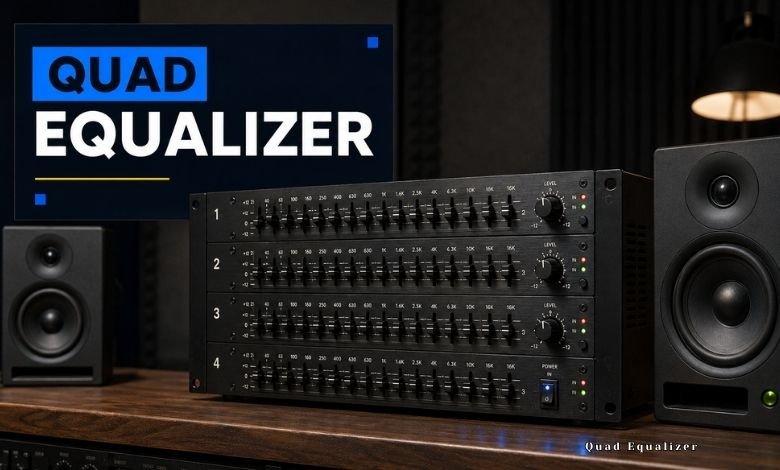
Some audio equipment disappears when new technology arrives. Other devices refuse to be forgotten. Four-channel equalizers belong to the second group. Their rows of sliders, illuminated displays and detailed controls continue to attract people who want more authority over the way their music sounds.
A quad equalizer was created for systems that send audio through four separate channels rather than the two channels used in ordinary stereo. It lets the listener change selected frequency ranges and balance the sound coming from front and rear speakers.
The technology is closely linked with the quadraphonic era, but its value is not limited to collectors. It can still support custom audio systems, music rooms and carefully restored vintage hi-fi equipment. Understanding how it works is the first step towards using it properly.
What a Quad Equalizer Actually Does
An equalizer changes the strength of different sound frequencies. It doesn’t add new sounds , or improve the quality of the original recording . Instead, it changes the balance between bass, mid-range and treble.
A standard stereo equalizer manages two channels: left and right. A quad equalizer is built to handle four. These are commonly arranged as front-left, front-right, rear-left and rear-right channels.
Each slider on the front panel represents a frequency band. The lowest bands control deep sounds such as bass drums and bass guitars. Middle bands affect voices, pianos and electric guitars, while the upper bands shape cymbals, strings and fine background details.
Moving a slider above its centre position increases that frequency. Pulling it below the centre reduces it. When all sliders remain in the middle, the response is described as flat because the equalizer is not deliberately changing the tonal balance.
The number of frequency bands differs between models. A basic unit may offer only a few controls for each channel, while a more advanced graphic equalizer can divide the sound into many smaller areas. More bands provide greater precision, although they also require more careful adjustment.
With a quad equalizer, users can correct differences between the front and rear of a room. Rear speakers may need slightly different treatment because they sit near curtains, furniture or reflective walls. Separate control makes it possible to respond to those conditions.
How Quadraphonic Sound Created a New Listening Style
In the early days of recorded music, listeners heard everything through a single channel. Stereo later brought a major change by separating sound between left and right speakers. Recordings became wider, and individual instruments gained a clearer position.
Audio companies wanted to take this experience further. During the 1970s, they promoted quadraphonic sound as the next step in home entertainment. Instead of using two speakers, a quadraphonic system placed four around the listener.
The idea was ambitious. A guitar might appear at the front of the room, supporting instruments could come from the rear, and selected effects might seem to move between the speakers. For the right recording, the listener was no longer simply facing the music. The music appeared to surround them.
Building such a system was not easy. Consumers needed four speakers, suitable amplification and recordings produced in a compatible quadraphonic format. Different companies also developed competing technologies, and not every record worked with every system.
The added expense and confusion limited its success. Most homes still had stereo, which was easier to install, and had a far bigger music catalog behind it.
However, the experiment was not a complete failure. It helped to establish the idea of multiple speakers creating a sound field of immersion. Home cinema surround sound later developed this concept with digital formats and additional channels.
Four-channel equalizers became useful because four speakers rarely sounded identical once placed inside a real home. Even matching speakers could produce different results because of their position. Equalisation allowed listeners to make practical corrections without rebuilding the room.
Why Room Acoustics Matter More Than Slider Patterns
Many people search for a perfect equalizer setting, but no single arrangement works in every room. The same equipment can sound warm and controlled in one space yet harsh or muddy in another.
Walls, floors, windows and furniture all influence audio. Hard surfaces reflect sound, while soft furnishings absorb some frequencies. Large empty rooms may produce noticeable echoes, whereas small rooms can make bass feel crowded.
Speaker position also changes the result. A speaker placed close to a wall often produces more bass than one positioned further into the room. Corner placement may strengthen low frequencies even more.
This can create an uneven four-channel system. The front speakers may sound clear, while the rear pair appears heavy or dull. Increasing the overall volume will not solve the problem because every frequency and channel becomes louder together.
Equalisation offers a more focused response. If bass dominates the rear channels, the relevant lower bands can be reduced. If the front speakers sound too bright, a small reduction in the upper range may create a smoother balance.
The human voice sits mainly within the mid-range, making this area particularly important. Too much mid-range can make music sound sharp or crowded. Too little can push singers and spoken dialogue into the background.
Changes should remain modest. Extreme boosts can introduce noise, encourage distortion and place unnecessary pressure on amplifiers or speakers. Cutting an overpowering frequency is often safer than boosting several other bands to compete with it.
The goal is not to create an impressive shape with the sliders. A dramatic pattern may look interesting but sound unnatural. The right setting is the one that allows music to feel balanced from the normal listening position.
A Practical Way to Set Up the Equipment
Begin with speaker placement rather than touching the frequency controls. Position the front pair at similar distances from the main seat. Place the rear speakers as evenly as the room permits.
Perfect symmetry may be impossible, particularly in a living room. One side might contain a window while the other has a sofa or bookcase. Even so, careful placement can reduce major problems before electronic correction begins.
The next step is connecting the device. Vintage amplifiers and receivers may use tape-monitor loops, preamplifier outputs or other dedicated connections. The exact method depends on the equipment.
Users should never assume that every older component connects in the same way. Incorrect wiring can cause weak output, missing channels, humming or feedback. The original manual, when available, is the safest guide.
After connecting the system, return every control to its centre position. Choose a familiar recording with natural vocals, steady bass and several instruments. Avoid starting with a poorly recorded song because its existing faults may lead to unnecessary adjustments.
Sit where you normally listen and pay attention to one issue at a time. If the bass sounds swollen, reduce the lower bands slightly. If vocals lack presence, make a small adjustment in the middle range and listen again.
Using a quad equalizer requires patience. Move one or two controls, then play the same part of the track again. Making several large changes at once makes it difficult to identify which adjustment helped.
A bypass function is useful during this process. It temporarily removes the equalisation so the listener can compare the altered signal with the original. Frequent comparisons help prevent the settings from becoming excessive.
Different recordings may still need different treatment. An older record, a radio broadcast and a modern digital track will not always share the same tonal balance. A neutral everyday setting is usually more practical than constantly rebuilding the sound for every song.
Is a Quad Equalizer Still Useful Today?
Modern home cinema receivers often include automatic room correction. A small microphone measures speaker distances, volume levels and acoustic behaviour. The receiver then creates digital adjustments for each channel.
Music-production software provides even more control. Digital tools can target extremely narrow frequency areas, save different settings and display sound information on screen. From a purely technical viewpoint, these systems are more flexible than most vintage hardware.
Yet traditional equipment offers a different experience. Physical sliders respond immediately, and every adjustment remains visible. There are no menus to open and no software screens between the listener and the system.
That direct control is one reason vintage hi-fi enthusiasts continue to buy four-channel units. Their metal cases, glowing indicators and mechanical controls also match the appearance of classic receivers, cassette decks and turntables.
Condition matters when purchasing an older model. Sliders may collect dust and produce crackling noises. Ageing internal components can cause hum, channel loss or an inconsistent signal.
Before buying, test every input, output and control if possible. Listen to all four channels separately and move each slider slowly. A clean exterior is attractive, but reliable internal performance is far more important.
Compatibility must also be checked. A vintage device may not connect directly to a modern receiver. Additional equipment can sometimes solve the problem, but complicated conversion may remove the simplicity that made the original unit appealing.
For an authentic quadraphonic installation, a serviced hardware equalizer can be a valuable addition. For a new home cinema, built-in digital processing will usually be easier and more precise. The better choice depends on the system and the listener’s priorities.
Conclusion
A quad equalizer represents an important stage in the development of multi-channel audio. It gave listeners detailed control over four speakers at a time when quadraphonic music promised to bring a more spacious experience into the home.
Modern digital systems now perform similar work with greater precision, but classic equalizers still offer practical value and physical appeal. When paired with compatible equipment, sensible speaker placement and restrained settings, they can produce clear and well-balanced sound.
The real skill lies in listening. Small, thoughtful adjustments can reveal details that were previously hidden, while excessive changes can quickly damage the natural character of the music.
(FAQs)
What is a quad equalizer used for?
It controls selected frequency bands across four audio channels. It can reduce unwanted bass, improve vocal presence and help balance front and rear speakers.
Is quadraphonic audio the same as modern surround sound?
No. Both use several speakers, but quadraphonic audio generally relies on four channels. Modern surround formats often include centre, side, rear and subwoofer channels with digital processing.
Can an equalizer fix poor-quality audio?
It can improve tonal balance, but it cannot restore information missing from the recording. Heavy noise, damage or severe distortion will remain.
What do the sliders control?
Each slider manages a particular frequency range. Lower sliders affect bass, middle controls shape voices and instruments, and higher bands influence brightness and fine detail.
Should every slider be raised for stronger sound?
No. Raising every band mainly increases the signal and may cause distortion. Equalisation works best when specific problems are corrected with small changes.
Is vintage four-channel equipment expensive?
Prices vary according to brand, condition, rarity and service history. A fully working unit may cost more than an untested example, but it is usually a safer purchase.