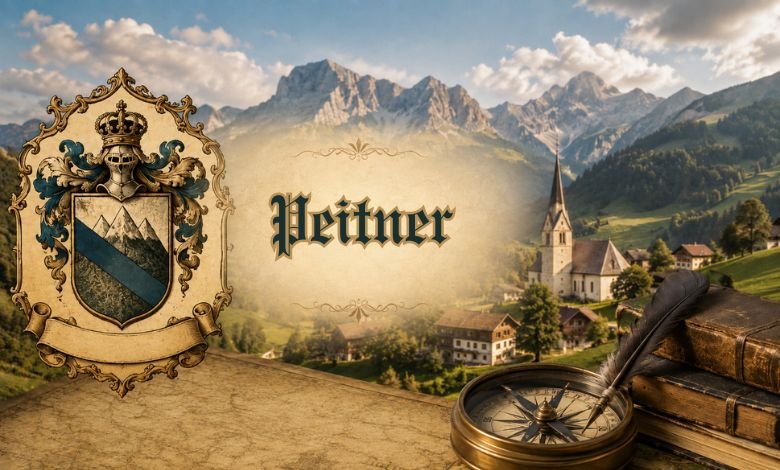
Some surnames are found almost everywhere. Others appear so rarely that seeing one can immediately raise questions about where it came from and what it once meant. Peitner belongs to the second group.
The name has strong historical links with German-speaking Central Europe, particularly Bavaria and Austria. Surname dictionaries connect it with older words describing mountainous landscapes, suggesting that it may originally have identified people by where they lived. Historical records also reveal related spellings and family branches stretching through Tyrol, the Puster Valley and other parts of the former Austrian lands.
Behind this unusual surname is a wider story about geography, migration, language and the way European family names evolved over generations.
What Does the Peitner Surname Mean?
The Peitner meaning is most commonly connected with geography. According to surname information published by FamilySearch, the German form is associated with Bavaria and Austria and may come from the Middle High German word līte, meaning a mountain slope or spur. The ending -(n)er can indicate a person who lived in or came from a particular place.
In practical terms, the surname could once have described somebody who lived near a slope, hillside or projecting part of a mountain.
This type of naming was common in medieval Europe. Before modern street addresses, identification often depended on simple details. One person might be known by his occupation, another by his father, and another by the landscape surrounding his home.
A family living beside a hill, woodland, river or valley could eventually inherit a surname connected with that location. Over generations, what began as a practical description became a permanent family name.
There is also another possible linguistic history. FamilySearch records an Ashkenazic Jewish interpretation in which the surname may be occupational, connected with the Yiddish verb meaning “to solder”.
This is an important reminder that surnames with the same spelling do not always come from one single family or one historical source.
Central European Roots and the Alpine Connection
The strongest geographical associations of the name lead towards Austria, Bavaria and neighbouring German-speaking communities.
The Alpine region is especially significant when studying old surnames. For centuries, communities were spread between valleys, farms, mountain settlements and small towns. People could remain closely connected to one area for many generations, allowing local family names to become deeply established.
Historical information concerning the closely related Peintner name provides a useful example. Records describe Peintner as an established surname in the Puster and Eisack valleys. One documented Friedrich Peintner, whose surname also appeared as Pewntner, was recorded in 1425. Other members of the family appear in later Tyrolean records.
The Puster Valley itself forms part of the historic Tyrolean cultural region and today runs through areas of South Tyrol and East Tyrol. This wider Alpine setting helps explain why related names can appear in records connected with modern Austria, Italy and neighbouring territories.
Political borders changed repeatedly across Central Europe. Families did not necessarily move when a border changed around them. As a result, somebody researching Austrian ancestry may discover records stored in locations that today belong to another country.
That makes geography just as important as spelling when investigating old European families.
Peintner, Peithner and Changing Family Names
One of the most interesting aspects of the Peitner surname is the existence of similar historical spellings.
Before spelling became standardised, names were often written according to pronunciation. A priest, government official or clerk might record the same family name differently from another official. Dialects, handwriting and movement between regions could create further changes.
The forms Peintner and Peithner therefore deserve attention during genealogical research, although similar spelling alone cannot prove that every person carrying these names belonged to the same family.
There is, however, documented evidence connecting particular Peintner and Peithner branches. Historical accounts of the Peithner von Lichtenfels family trace that line back to an older Peintner family from the Puster Valley. Johann Christian Peithner later moved to Bohemia, and descendants of the family became associated with mining, government service and the Austrian nobility.
In 1780, Johann Thaddäus Peithner and his brother Joseph Wenzel received Austrian noble status with the designation “von Lichtenfels”. Johann Thaddäus became known for his work in mining administration, mineralogy and metallurgy.
These records are fascinating, but they should not be interpreted as proof that every modern person with a similar surname descends from this particular branch.
Genealogy works through documented connections, not surname similarity alone.
How to Research Peitner Family History
For someone carrying an uncommon surname, tracing a family tree can sometimes be easier than expected because there may be fewer unrelated records to examine. At the same time, spelling variations can make the process more complicated.
The best starting point is usually the most recent information that can be verified. Birth certificates, marriage documents, death records, passports, family Bibles and older photographs may reveal names, dates and locations.
From there, researchers can move backwards one generation at a time.
Church records can be especially valuable for Central European genealogy. Baptism, marriage and burial registers often existed long before modern civil registration systems. Historical family research in Austria can therefore involve Catholic parish records alongside government documents and local archives.
Researchers should also search alternative spellings rather than relying on one exact version. Peintner and Peithner may be worth checking when the location and dates make a connection plausible.
Migration records can provide another clue. During the nineteenth and twentieth centuries, many Central European families moved to the United States and other countries. A surname could change slightly after migration because officials recorded it phonetically, family members simplified the spelling, or later generations adopted a different form.
Modern genealogy databases can help locate records, but online family trees should be treated as clues rather than unquestionable evidence. Each relationship should ideally be supported by original documents.
Why Rare Surnames Matter More Than Their Numbers
A rare surname is more than an unusual word on a family tree. It can preserve traces of language, landscape and migration that might otherwise disappear.
The story behind Peitner illustrates how names could grow from the physical environment around a community. Mountains, slopes and valleys were not simply scenery for medieval families. They influenced where people built homes, cultivated land, travelled and formed communities.
The surname also demonstrates how language changes. A name recorded by one generation may look different several centuries later while still sharing a historical connection.
Modern distribution information suggests that closely related forms remain uncommon. Genealogy databases describe Peintner as relatively rare, with records continuing to appear in European countries including Austria and Italy.
For descendants, this rarity can make family research particularly rewarding. A single parish record, migration document or forgotten spelling can sometimes connect generations separated by hundreds of years.
At the same time, responsible research requires caution. Similar names, family crests and online family trees should never replace documented genealogical evidence.
Conclusion
The history of Peitner offers a small but fascinating window into the development of European surnames. Its strongest recognised interpretation connects the name with the mountainous landscape of German-speaking Central Europe, while historical records reveal similar spellings associated with Tyrol, the Puster Valley and later Austrian and Bohemian family branches.
Yet a surname can only provide the beginning of an ancestry story. Different families may have acquired similar names independently, spellings changed over centuries, and migration carried names far beyond their original communities.
For anyone researching this rare family name, the most exciting discoveries may therefore be waiting not in modern surname databases, but in old parish books, certificates and local archives where individual family stories were first recorded.
(FAQs)
What is the origin of Peitner?
The surname is strongly associated with German-speaking Central Europe, particularly Bavaria and Austria. One recognised explanation links it with a Middle High German term referring to a mountain slope or spur.
Is Peintner the same surname?
Peintner is a closely related historical spelling worth considering during family research. However, spelling similarity does not automatically mean that every Peintner and Peitner family shares the same ancestry.
What does the surname mean?
Its German topographic interpretation refers to someone living near a mountain slope or spur. A separate Ashkenazic Jewish interpretation recorded by FamilySearch associates the name with an occupation involving soldering.
Where were Peintner families historically found?
Historical accounts place established Peintner families in Tyrol, including the Puster and Eisack valleys. Records relating to individual branches stretch back several centuries.
Is Peithner connected with Peintner?
At least one documented historical branch is. The Peithner von Lichtenfels family is described as descending from an older Peintner family from the Puster Valley before a branch moved to Bohemia.
How can I trace this family name?
Begin with verified family documents and work backwards through civil registrations, parish registers, census information, migration documents and historical archives. Search spelling variations as well, but confirm every generation with reliable records.