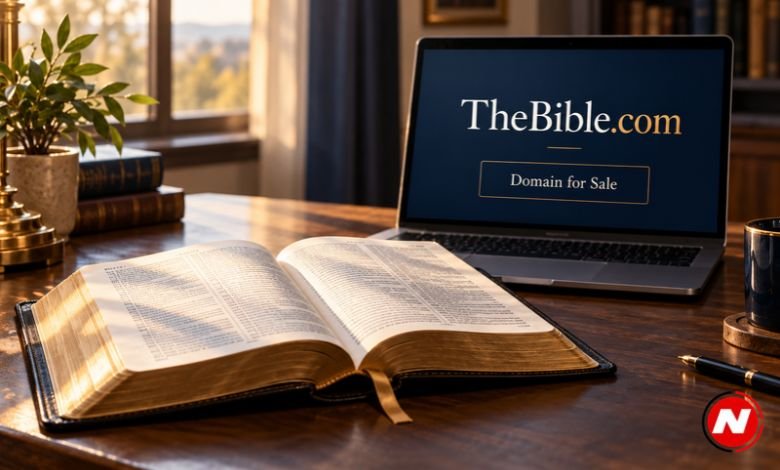
A website name can set a clear expectation. Type TheBible.com into a browser, and you might expect to find Scripture ready to read. Perhaps you are looking for a familiar passage, a daily verse or a place to begin reading the Bible for the first time. What appears today is different: the address redirects to a page offering the domain for sale.
The confusion grows because Bible.com, a separate website with a very similar name, does offer free Bible reading. A few letters change the result completely. For anyone trying to find Scripture online, it helps to know which address leads to an active reading service and which currently leads to a domain sale page.
What do visitors find at TheBible.com?
At present, TheBible.com redirects visitors to a page where the domain name is offered for sale. It does not open to a list of Bible books or a reader where you can select a chapter and verse.
That is easy to miss when the address itself sounds so direct. Someone may type it from memory, expecting the words “the Bible” in the name to describe what the site provides. The page that opens tells a different story.
A domain name is a web address. The content available at that address can change over time. A domain might point to a full website, a temporary page or, as in this case, a sales listing. Its name alone cannot confirm what visitors will find there.
The sale page shows the current situation, but it does not explain the domain’s full history. It does not establish why the address is for sale or what a future buyer may do with it. Those questions cannot be answered simply by looking at the redirect.
If you arrived hoping to read Scripture, the useful point is this: the address is not currently functioning as an online Bible. You will need a different reading site to find the text you came for.
The difference between TheBible.com and Bible.com
It takes only one extra word to change a web address. In conversation, people might use “the Bible website” to describe a place where they read online. In a browser, however, TheBible.com and Bible.com are two separate destinations.
Bible.com is an active Bible reading website run by YouVersion. Visitors can start reading Scripture there and explore material such as Bible audio, daily verses and reading plans. The service describes its Bible access as free.
TheBible.com currently leads to a domain sale page. The similar names do not make the websites the same service. If someone tells you to visit Bible.com, adding “the” at the beginning will take you somewhere else.
This kind of mistake can happen without anyone noticing at first. A person may remember the topic of a website but forget its exact address. They might also click a bookmark labelled “Bible” without checking the domain saved behind it.
The simplest habit is to read the address bar after a page loads. The heading on a search result or the name of a bookmark may describe what you hoped to find. The address bar shows where you actually landed.
What can you do on an online Bible website?
For someone seeking a passage, the first need is simple: find the right book and chapter, then read the text clearly. Bible.com offers that starting point through its online reader. It also provides ways to listen and to follow Bible reading plans.
Those options suit different readers. One person may want to check a single verse mentioned in a conversation. Another may want to read an entire chapter slowly. Someone new to the Bible may prefer a plan that gives them a smaller reading for each day.
Audio offers another way to follow Scripture, especially when reading from a screen is inconvenient. Daily verses and plans can also help a reader return regularly. None of these features is necessary for a first visit; opening a passage is enough to begin.
When using any online Bible, pay attention to the translation named on the page. Two English translations may express the same passage in different words. If you are following a lesson, study group or printed guide, knowing the version helps you compare the text accurately.
It is also helpful to keep the book, chapter and verse together when making a note. A phrase copied without its reference can be difficult to find again. A clear reference lets you return to the passage and read the words around it for context.
These small details make an online Bible more useful than a page that merely displays a quotation. A reader can move from a single line to the full chapter, check what comes before and after it, and build a clearer understanding of the passage.
Why checking the exact address matters
The difference here is practical. A visitor searching for Scripture could lose time on a page that has no reading tool, simply because its name looks right. Checking the full address takes a moment and clears up the confusion.
It also prevents an inaccurate description from spreading. Calling a domain an online Bible because of its name would give other readers the wrong expectation. The more reliable approach is to describe what the address actually displays when checked.
Website content can change. A domain offered for sale today might have a different purpose later, while an active service may add or remove features. For that reason, claims about a website’s present state should be tied to what visitors can see now.
This does not require any technical knowledge. Look at the address, see whether the page contains the service you need, and check the site’s own description when you want to know what it offers. If you intended to read the Bible, a working Bible reader should let you reach the text without guessing where it is hidden.
In this case, the distinction is clear. One address currently presents a domain for sale. The other provides a free route to Bible passages. Knowing which is which saves a reader a needless detour.
Conclusion
TheBible.com sounds like an obvious destination for Scripture, but it currently redirects to a page offering the domain for sale. Bible.com is a separate, active website where people can read the Bible for free. When two addresses are this similar, checking the exact name is the quickest way to reach the content you intended to find.
(FAQs)
Is TheBible.com an online Bible?
It does not currently appear to be one. The address redirects to a page offering the domain for sale rather than a page where visitors can read books and chapters of Scripture.
Is TheBible.com the same website as Bible.com?
No. They are separate domains. Bible.com provides free online Bible reading through YouVersion, while the other address currently leads to a domain sale page.
Why does the name sound like a Bible reading site?
The words in the domain naturally suggest that subject. A domain name, however, does not guarantee that the website currently offers content related to its name.
Where can I read the Bible online for free?
Bible.com is one option. Its homepage lets visitors begin reading and also presents audio, daily verses and Bible reading plans.
Could the website change in the future?
Yes. What a domain displays can change, particularly if it is sold. The current sale page does not reveal what any future owner would choose to publish there.