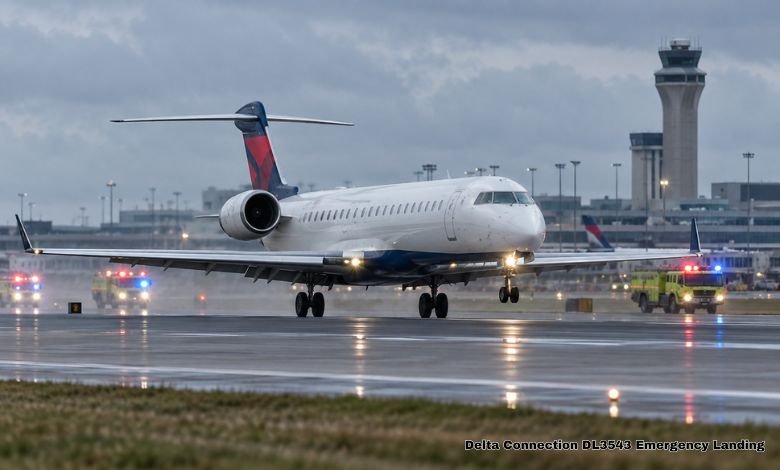
The Delta Connection DL3543 emergency landing became an aviation talking point after a regional passenger jet turned back to Minneapolis only minutes into its journey. On 7 July 2025, flight DL3543 departed Minneapolis–Saint Paul International Airport for Chicago Midway International Airport, but the trip did not go as planned.
The aircraft stopped climbing at roughly 21,000 feet and began heading back towards Minneapolis about 10 minutes after departure. During the return, the crew used emergency transponder code 7700, alerting air traffic control that the flight required priority handling. The aircraft landed safely at Minneapolis approximately 37 minutes after leaving the airport.
While the safe outcome is clear, one major question remains: what caused the crew to declare the emergency? Available contemporary reporting did not confirm a specific technical fault.
What Happened During the Delta Connection DL3543 Emergency Landing?
Delta Connection flight DL3543 was operating a relatively short domestic journey from Minneapolis–Saint Paul International Airport (MSP) to Chicago Midway International Airport (MDW) on 7 July 2025.
The aircraft involved was registration N259SY, an Embraer E175LR. Current aircraft records identify N259SY as being operated by SkyWest Airlines under the Delta Connection brand.
At first, the departure appeared routine. The regional jet climbed after leaving Minneapolis, but the flight did not continue towards its normal cruising level. Instead, the climb stopped at approximately 21,000 feet.
About 10 minutes after take-off, the aircraft turned back towards Minneapolis. Contemporary aviation reporting then recorded the aircraft transmitting transponder code 7700, indicating an emergency situation.
Rather than continuing towards Chicago, the pilots returned to the airport they had just departed. The decision meant the aircraft could reach a major airport quickly, where air traffic controllers and ground services could prepare for its arrival.
The flight eventually landed on runway 12R at Minneapolis–Saint Paul International Airport. The total journey lasted about 37 minutes from departure to landing, after which the aircraft was reported at stand C12.
For passengers following the situation in real time, a sudden turnback and emergency declaration may have sounded alarming. However, declaring an emergency also gives pilots and controllers more flexibility to deal with an abnormal situation safely.
Why Did the Crew Use Squawk Code 7700?
One of the most important details in the Delta Connection DL3543 emergency landing was the use of transponder code 7700.
Aircraft transponders communicate identifying and altitude-related information to air traffic control radar systems. Different numerical codes can also indicate certain special situations.
According to guidance from the US Federal Aviation Administration, Code 7700 is associated with an emergency. FAA guidance explains that when a distress or urgency condition occurs, an aircraft can squawk 7700 to alert a ground radar facility. The code normally creates a special emergency indication for controllers.
Using 7700 does not, by itself, reveal exactly what was wrong with an aircraft.
An emergency declaration can be made for many reasons. These can range from a technical warning to a medical emergency or another condition that makes priority handling sensible.
In the case of DL3543, the important confirmed fact is that the pilots treated the situation seriously enough to return to Minneapolis and use the emergency code.
Air traffic controllers can then give the affected flight appropriate assistance and reduce delays caused by other traffic. This allows the pilots to focus on handling the aircraft and completing the safest available course of action.
What Caused Flight DL3543 to Turn Back?
This is where the story requires particular care.
Several articles published after the incident have offered explanations for the Delta Connection DL3543 emergency landing, including claims involving pressurisation or electrical problems. However, the contemporary AIRLIVE report documenting the return did not identify a specific technical cause.
That distinction matters because an aircraft stopping its climb does not automatically prove that one particular system has failed.
Pilots may level an aircraft, turn around or request priority handling for a wide variety of reasons. Without an airline statement, official investigation document, maintenance record or another reliable primary source, it would be misleading to present one theory as confirmed fact.
Some later online accounts have even provided conflicting details about what occurred. That makes it especially important to separate the known flight movements from speculation.
What can be established is straightforward: DL3543 stopped climbing at approximately 21,000 feet, returned towards Minneapolis roughly 10 minutes after departure, squawked 7700 and landed safely about 37 minutes after taking off.
The exact cockpit indication or operational concern that triggered those actions has not been established by the reliable contemporary source covering the event.
How the Emergency Return Shows Aviation Safety Procedures at Work
The Delta Connection DL3543 emergency landing is also an example of how aviation crews can respond conservatively when something unexpected develops.
Commercial pilots do not have to wait until an abnormal condition becomes a severe crisis before changing their plans. If continuing the journey creates unnecessary uncertainty, returning to a suitable airport can be the safer option.
That appears particularly logical when a problem develops soon after departure. The departure airport is nearby, controllers already know the aircraft’s position, and airport services can prepare for its return.
In DL3543’s case, Minneapolis–Saint Paul was also a major airport capable of handling the regional jet.
The use of squawk 7700 gave air traffic control another clear indication that the aircraft required emergency handling. FAA procedures specifically recognise the code as an emergency signal.
For people outside aviation, the phrase “emergency landing” can create an image of an aircraft barely reaching the runway. In reality, the term covers a much wider range of situations.
A pilot may declare an emergency precisely because doing so creates additional safety margins. Priority handling, rapid coordination and an early return can prevent an uncertain problem from becoming a more serious one.
That does not mean an emergency should be treated casually. It means the declaration itself is part of the safety system.
Latest Information About the DL3543 Incident
More than a year after the July 2025 event, the basic sequence surrounding the flight remains clearer than its underlying cause.
The aircraft involved, N259SY, continues to be identified in flight-tracking records as an Embraer E175LR operated by SkyWest Airlines for Delta Connection.
However, later articles discussing the event have not always agreed on the reason for the emergency. Some have claimed a pressurisation problem, while others have described electrical issues or other technical concerns.
Those claims should not automatically be treated as established details.
The safest account is therefore the one supported by the contemporary record: the Minneapolis-to-Chicago flight turned back shortly after departure, declared an emergency using code 7700 and made a safe return to Minneapolis.
Until stronger documentation establishes what happened inside the cockpit or which aircraft system prompted the decision, the precise cause should remain described as unconfirmed.
This is particularly important for aviation stories, where technical-sounding details can spread quickly online even when their original source is unclear.
Conclusion
The Delta Connection DL3543 emergency landing ended safely after what began as an ordinary journey from Minneapolis to Chicago changed within minutes of take-off.
Flight DL3543 stopped its climb near 21,000 feet, turned back towards Minneapolis, used emergency transponder code 7700 and landed approximately 37 minutes after departure. The sequence demonstrates how pilots and air traffic controllers can respond quickly when an unexpected situation develops.
What caused the emergency remains the less certain part of the story. Until reliable primary evidence confirms a specific fault, claims about pressurisation, electrical systems or another technical failure should be regarded as unverified.
The most important confirmed outcome is much simpler: the crew changed course, received priority handling and brought the regional jet safely back to Minneapolis.
(FAQs)
What happened to Delta Connection flight DL3543?
The flight departed Minneapolis for Chicago Midway on 7 July 2025. It stopped climbing at about 21,000 feet, turned back roughly 10 minutes after departure and returned safely to Minneapolis.
Where did DL3543 make its emergency landing?
The aircraft returned to Minneapolis–Saint Paul International Airport, the same airport from which it had departed. It was reported to have landed on runway 12R.
What does squawk 7700 mean?
Squawk 7700 is an emergency transponder code. FAA guidance states that it can be used to alert air traffic control when an aircraft is experiencing a distress or urgency condition.
What aircraft was operating flight DL3543?
The aircraft was N259SY, an Embraer E175LR. Flight-tracking records identify SkyWest Airlines as the operator under the Delta Connection brand.
What caused the Delta Connection DL3543 emergency landing?
The precise cause has not been confirmed by the contemporary report documenting the incident. Later websites have offered different technical explanations, but these should be treated cautiously without stronger supporting evidence.
How long was DL3543 in the air?
The aircraft landed back at Minneapolis approximately 37 minutes after departure, according to the contemporary aviation report.