49ers vs Cleveland Browns Match Player Stats: Inside San Francisco’s 26–8 Win and the Plays That Changed Everything

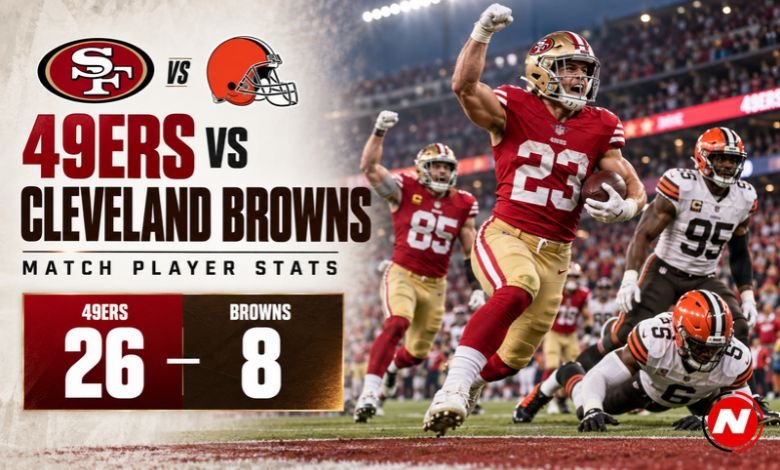
The 49ers vs Cleveland Browns match player stats tell a rather surprising story. San Francisco walked away with a comfortable 26–8 victory on 30 November 2025, yet Cleveland actually gained one more yard during the game. The difference came down to what each team did when it mattered.
At Huntington Bank Field, Brock Purdy threw for 168 yards and one touchdown, while Christian McCaffrey added another score on the ground. George Kittle made several important catches, and Clelin Ferrell caused problems for Cleveland’s offensive line.
The Browns had their moments, too. Rookie quarterback Shedeur Sanders threw a touchdown pass, and Quinshon Judkins led both teams in rushing. But missed opportunities, costly fumbles and San Francisco’s sharp third-down play eventually settled the contest.
49ers vs Cleveland Browns Match Overview: How the Game Unfolded
It was a cold Sunday afternoon in Cleveland, with strong winds making conditions difficult for both teams. San Francisco arrived hoping to continue its winning run, while the Browns were looking for a result that might lift spirits during a tough season.
The opening quarter gave the visitors exactly what they wanted.
Skyy Moore returned a punt 66 yards, putting San Francisco just 16 yards away from Cleveland’s end zone. Six plays later, Christian McCaffrey crossed the goal line from one yard out. The 49ers were ahead 7–0.
Cleveland did not disappear from the contest. Its running game began to find space, and Shedeur Sanders gradually settled into his passing rhythm.
Late in the second quarter, Sanders found Harold Fannin Jr. for a 34-yard touchdown. Quinshon Judkins then ran in the two-point conversion, putting the Browns ahead 8–7.
For a brief moment, the home crowd had reason to believe an upset was possible.
But the 49ers responded quickly. Purdy moved the ball downfield, and Matt Gay kicked a 25-yard field goal as the first half ended. San Francisco went into the break leading 10–8.
The second half was a different story.
Cleveland failed to add another point. Purdy scored on a two-yard run in the third quarter, while Jauan Jennings caught a seven-yard touchdown pass early in the fourth.
A final field goal from Gay stretched the advantage to 26–8, ending Cleveland’s hopes of a comeback.
Final Match Score
| Quarter | 49ers | Browns |
|---|---|---|
| First | 7 | 0 |
| Second | 3 | 8 |
| Third | 7 | 0 |
| Fourth | 9 | 0 |
| Final | 26 | 8 |
The victory moved San Francisco to 9–4 for the season. Cleveland, meanwhile, fell to 3–9.
San Francisco 49ers Player Stats: Who Made the Biggest Impact?
The 49ers vs Cleveland Browns match player stats show that San Francisco did not need a spectacular passing display to win. Instead, the visitors relied on a handful of timely plays from their most trusted attacking players.
Brock Purdy Kept His Composure
Purdy’s final numbers were fairly modest. He completed 16 of 29 passes for 168 yards, one touchdown and no interceptions.
There were missed throws and drives that ended without points. Cleveland’s defence made him work for his completions, particularly when the 49ers tried to move the ball through the air.
Still, Purdy managed the game without giving Cleveland an interception.
His two-yard rushing touchdown in the third quarter came at an important time. San Francisco had been leading by just two points, and the score finally gave the visitors some breathing room.
He later connected with Jauan Jennings for another touchdown, making his contribution two total scores.
Christian McCaffrey Did the Hard Work
McCaffrey finished with 53 rushing yards on 20 carries. His average of 2.7 yards per carry suggests Cleveland did a reasonable job of limiting his running space.
But McCaffrey was still useful near the goal line, scoring San Francisco’s first touchdown.
He added 21 receiving yards from four catches, giving Purdy a dependable short passing option.
There were no huge rushing plays from McCaffrey in this contest. His contribution was about making difficult yards and helping San Francisco keep possession.
George Kittle and Jauan Jennings Delivered
George Kittle was San Francisco’s leading receiver, making four catches for 67 yards. His longest reception went for 33 yards.
Kittle’s ability to find space helped the 49ers move the chains on an afternoon when big gains were not easy to come by.
Jennings finished with four receptions for 39 yards. His seven-yard touchdown in the fourth quarter was particularly important because it came after a Cleveland special teams mistake.
San Francisco 49ers Offensive Statistics
| Player | Category | Key Stats |
|---|---|---|
| Brock Purdy | Passing | 168 yards, 1 TD |
| Christian McCaffrey | Rushing | 53 yards, 1 TD |
| Brian Robinson Jr. | Rushing | 26 yards |
| George Kittle | Receiving | 67 yards, 4 catches |
| Jauan Jennings | Receiving | 39 yards, 1 TD |
| Kyle Juszczyk | Receiving | 27 yards |
| Christian McCaffrey | Receiving | 21 yards |
| Ricky Pearsall | Receiving | 14 yards |
What stands out here is the balance. Nobody produced an enormous individual total, but San Francisco found enough contributions across its attack to keep Cleveland under pressure.
Cleveland Browns Player Stats: Strong Efforts Without the Result
Cleveland’s final score does not tell the whole story of its offensive performance.
The Browns ran for more yards than San Francisco and produced a touchdown drive that briefly put them in front. Unfortunately, they could not repeat that success after the interval.
Shedeur Sanders Showed Promise Under Pressure
Shedeur Sanders completed 16 of 25 passes for 149 yards, one touchdown and no interceptions.
His connection with Harold Fannin Jr. was the highlight of Cleveland’s afternoon. The 34-yard touchdown came at the end of a 90-yard drive, showing what the Browns could achieve when their attack worked together.
Sanders also faced plenty of pressure from San Francisco’s defensive front.
He was sacked three times for a combined loss of 34 yards. Those plays put the Browns in difficult situations and made it harder to sustain their drives.
His performance had encouraging moments, but Cleveland needed more consistency around him.
Quinshon Judkins Was Cleveland’s Best Runner
Judkins had one of the better individual performances in the game.
He rushed 23 times for 91 yards, averaging four yards per carry. That made him the leading rusher across both teams.
The young running back was willing to take contact and fight for extra distance. His 17-yard run was Cleveland’s longest rushing gain of the day.
He also caught three passes for 18 yards and successfully ran in the two-point conversion following Fannin’s touchdown.
For much of the first half, Cleveland’s running attack looked capable of troubling San Francisco.
The problem was that those positive rushing plays rarely led to points.
Harold Fannin Jr. Scored Cleveland’s Only Touchdown
Fannin caught three passes for 43 yards, including the 34-yard touchdown that gave Cleveland its only points-producing drive.
His performance contained both a high point and a costly mistake.
In the third quarter, Fannin lost a fumble that gave San Francisco possession at Cleveland’s 32-yard line. The 49ers used that opportunity to score Purdy’s rushing touchdown.
It was a frustrating afternoon for a player who had already shown he could make a difference in the passing game.
Cleveland Browns Offensive Statistics
| Player | Category | Key Stats |
|---|---|---|
| Shedeur Sanders | Passing | 149 yards, 1 TD |
| Quinshon Judkins | Rushing | 91 yards |
| Dylan Sampson | Rushing | 23 yards |
| Harold Fannin Jr. | Receiving | 43 yards, 1 TD |
| Jerry Jeudy | Receiving | 26 yards |
| Gage Larvadain | Receiving | 23 yards |
| Quinshon Judkins | Receiving | 18 yards |
| Jerome Ford | Receiving | 17 yards |
The 49ers vs Cleveland Browns match player stats make one thing clear: Cleveland had enough individual talent to compete for parts of the afternoon. What the team lacked was the ability to finish its promising possessions.
Defence, Turnovers and the Numbers That Decided the Match
The biggest story was not Purdy’s passing total or McCaffrey’s rushing yards. It was how often Cleveland helped San Francisco by giving away good field position.
Clelin Ferrell Made Life Difficult for Sanders
Defensive lineman Clelin Ferrell was outstanding for San Francisco.
He recorded nine combined tackles and two sacks, including a 13-yard sack in the second quarter that stopped a Cleveland drive.
His pressure repeatedly forced the Browns to deal with long-yardage situations.
Keion White added another sack, while Malik Mustapha and Upton Stout each recorded seven combined tackles.
Cleveland had its own defensive contributors.
Rookie linebacker Carson Schwesinger finished with 10 combined tackles, while Myles Garrett recorded a sack against Purdy.
The Browns’ defence was not completely overwhelmed. In fact, it limited San Francisco to just 91 rushing yards. But Cleveland’s mistakes on offence and special teams repeatedly put that defence in difficult positions.
Two Lost Fumbles Changed the Second Half
Fannin’s third-quarter fumble was the first major turning point after half-time.
San Francisco recovered the ball and began a drive in excellent field position. Purdy eventually scored, extending the visitors’ advantage to 17–8.
Then came another error.
Early in the fourth quarter, Gage Larvadain muffed a punt, and Darrell Luter Jr. recovered it for the 49ers at Cleveland’s 18-yard line.
Six plays later, Jennings caught his touchdown pass.
Just like that, a contest Cleveland had kept close became a 23–8 game.
Comparing the Team Statistics
| Match Statistic | 49ers | Browns |
|---|---|---|
| Total Net Yards | 252 | 253 |
| Rushing Yards | 91 | 138 |
| Net Passing Yards | 161 | 115 |
| First Downs | 19 | 15 |
| Third-Down Conversions | 11/17 | 3/11 |
| Fourth-Down Conversions | 0/0 | 0/4 |
| Fumbles Lost | 0 | 2 |
| Sacks Made | 3 | 1 |
These figures explain more than the final score alone.
Cleveland gained 253 net yards, compared with San Francisco’s 252. Yet the Browns converted only three of their 11 third downs and failed on all four fourth-down attempts.
San Francisco, by contrast, converted 11 of 17 third downs.
That was a major difference. The 49ers were able to extend drives, keep their defence off the field and make better use of scoring chances.
Cleveland also failed to reach the red zone throughout the game. Its only touchdown came on a pass from outside the 20-yard line.
This is why the 49ers vs Cleveland Browns match player stats are so interesting. The teams were almost level in total yardage, but one side handled the important situations far better than the other.
For San Francisco, this was the kind of win that matters during a playoff chase. It was not always pretty, yet it showed a team capable of taking advantage when an opponent makes mistakes.
Conclusion
The 49ers vs Cleveland Browns match player stats show just how misleading a final score can sometimes be. San Francisco won by 18 points, even though Cleveland finished with one more net offensive yard.
Purdy made the important plays without throwing an interception. McCaffrey found the end zone, Kittle offered a reliable target, and Ferrell gave Sanders little room to settle.
Cleveland had reasons to feel disappointed. Judkins ran well, Sanders produced a fine touchdown pass, and the Browns briefly led before half-time. But two lost fumbles and poor third-down execution took away their chance of building on those moments.
San Francisco left Cleveland with a 26–8 win and its third straight victory. The score was comfortable in the end, but it was the smaller moments a punt return, a recovered fumble and a converted third down that made the difference.
(FAQs)
Who won the 49ers vs Cleveland Browns game in 2025?
The San Francisco 49ers beat the Cleveland Browns 26–8 on 30 November 2025 at Huntington Bank Field in Cleveland. San Francisco scored 16 unanswered points during the second half.
What were Brock Purdy’s passing stats against Cleveland?
Brock Purdy completed 16 of 29 passes for 168 yards, one touchdown and no interceptions. He also rushed for a touchdown, finishing the game with two total scores.
How many yards did Christian McCaffrey gain?
Christian McCaffrey rushed for 53 yards on 20 carries and scored one touchdown. He also caught four passes for 21 receiving yards.
Who was Cleveland’s best offensive player?
Quinshon Judkins was one of Cleveland’s most productive players. He rushed for 91 yards, caught three passes for 18 yards and scored a two-point conversion. Harold Fannin Jr. scored Cleveland’s only touchdown.
Why did the Browns lose despite gaining more yards?
Cleveland struggled on third and fourth downs, lost two fumbles and failed to score in the second half. San Francisco made better use of field position and turned the Browns’ mistakes into touchdowns.